Reciprocal Teaching: A Practical 4-Step Strategy That Builds Reading Comprehension
reviewed by Marvi M. Andres
Updated on July 23, 2026
Key Points:
- Reciprocal teaching is a reading comprehension strategy Palincsar and Brown developed in 1984, which shows how students can achieve better reading comprehension skills.
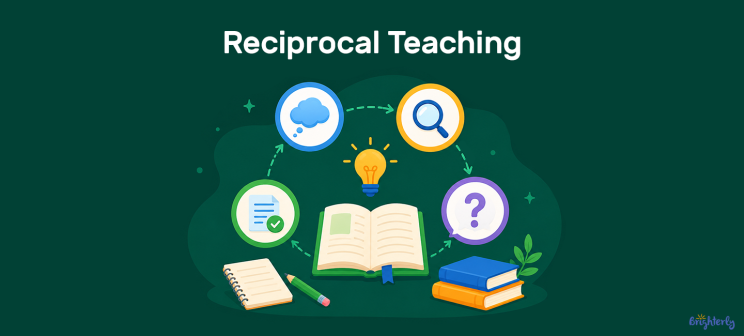
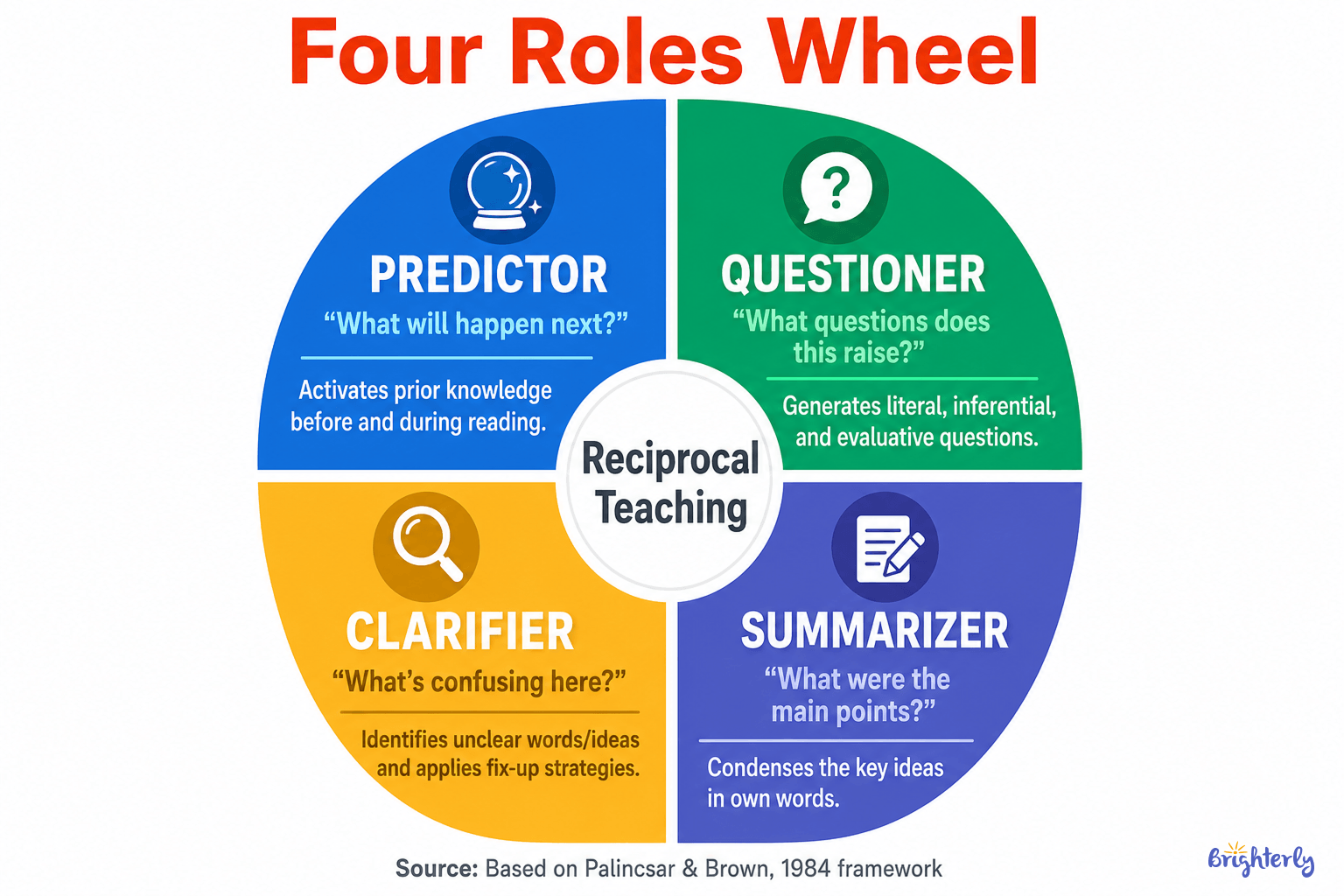
- The method uses the four rotating roles of a Predictor, Questioner, Clarifier, and Summarizer to make text comprehension an active process while kids are reading the text, not after
- Studies over the years have shown that reciprocal teaching is an effective strategy that significantly improves reading comprehension skills in relatively short time periods.
Often, students can read words on the page and finish the passage without understanding what it actually said. This is because they weren’t taught how to work through the text while reading it. Reciprocal teaching can fix that. Read to learn what reciprocal teaching is, why the research behind it is so strong, and how you can bring it to your classroom or home.
What Is Reciprocal Teaching?
Reciprocal teaching is a structured reading comprehension strategy Annemarie Palincsar and Ann L. Brown developed in 1984. The strategy has four defined roles (Predictor, Questioner, Clarifier, and Summarizer), and during a group reading session, each student rotates through all four roles. Each role targets and helps the kids develop a specific comprehension skill, while also shifting the responsibility for understanding the text from the teacher to the student.
Where the Strategy Comes From
Palincsar and Brown developed reciprocal learning in the early 1980s. They grounded it in Vygotsky’s concept of the zone of proximal development, suggested in 1978. The idea behind this concept is that students learn best when they work just beyond their current ability with the support of a more knowledgeable guide.
The original research by Palincsar and Brown showed significant reading fluency and comprehension gains in students who used the strategy consistently over a period of around 2 weeks of the study. During the study, students improved from roughly ~30% accuracy on baseline comprehension assessments to ~70-80% after consistent use of the strategy.
Since then, multiple studies have validated the reciprocal teaching strategy as one of the most effective reading comprehension strategies available to educators. The most notable and highly cited resource is the 1994 reviews of this existing meta-analysis by Rosenshine et al., which reviewed 16 studies on this reading strategy. According to these studies, reciprocal reading develops text comprehension on a deeper level, shifting away from summaries that consisted mainly of details and toward summaries that included main ideas.
The right reading strategy makes all the difference!
Turn your passive reader into a confident and curious learner. 

Explore Brighterly Learning Experience
Learn exactly how Brighterly helps students thrive through expert sessions, online tools, and proven feedback from thousands of satisfied parents
The 4 Roles in Reciprocal Teaching
During a reciprocal teaching session, students rotate through four defined roles. Each role targets a specific comprehension skill. The goal is to move the group from reading the text passively to actively making sense of it through close reading and a student-led discussion. Let’s look at the four reciprocal teaching roles in more detail.
Predicting
In the role of the predictor, your child will use the clues from the text, like headings, intro, and conclusion, and images, to guess what the text is about and what will come next. This helps to set the purpose of the reading and show the group what’s coming before they move to the next section.
In practice, this may sound like “I predict the next section will explain why the water cycle speeds up in summer, because the last paragraph mentioned heat.” The goal is not to have a perfect guess, but to use small clues and pay attention to detail.
Questioning
Questioning means your child asks questions before, during, or after reading to identify the ideas the text is actually built around. They then pose those questions to the whole group, and they try to answer the questions together.
Palincsar and Brown have found in their research that with such as effective practice, the questioning strategy among the kids improved, and during the studies, main idea questions increased from 54% to 70% of the total.
Clarifying
As a clarifier, your child will need to flag anything that slowed down the group. This can be an unfamiliar word, a confusing sentence, or a reference kids didn’t understand. They may need to reread the sentence, break a long paragraph into smaller parts, try to find context clues, or try to understand the meaning of unfamiliar words. The clarification stage is also when a log of vocabulary development happens.
This role teaches kids not only how to work through harder texts, but also that confusion is part of reading. Instead of skipping difficult parts or giving up on the text altogether, they learn to approach it bit by bit. A good starter in practice can be saying “The confusing part is” or “From context, it likely means…”
Summarizing
As the summarizer, your kid will close the section by stating the main idea in one or two sentences, and, most importantly, in their own words. It’s key that they don’t just copy the summary using the words from the text. The summary should show that they understood after reading the text.
A simple CER frame that students can use to organize their answer is this: “The text mainly says… I know this because…” This keeps the summary short, but addresses all of the key points.
“Reciprocal reading is a metacognitive strategy that does NOT work on most standardized tests like SAT/ACT/ SHSAT as it orbits around comprehension without producing any.”
Summarizing is probably the closest to being directly useful, since most tests will include 2-4 main idea questions.


Why Reciprocal Teaching Works
The method draws directly on Vygotsky’s concept of the zone of proximal development mentioned earlier, which is the idea that if students work just slightly beyond their comfort zone, while there is a more knowledgeable person around for guided reading and learning, they perform most effectively.
In a reciprocal teaching session, the teacher initially shows the kids what this kind of skilled thinking looks like in practice. They then gradually hand that responsibility to the kids, intervening less and less, and effectively putting kids in charge of the content. This is a strategy similar to scaffolding.
The four roles also target metacognition, which is the ability to notice your own understanding, or lack of it, while you read.
The research on the effects and benefits of reciprocal teaching supports this. Palincsar and Brown found that students who used reciprocal teaching improved their comprehension scores from roughly ~30-40% at the baseline to 70-80% over a period of 12 sessions, although for best results, Palincsar and Brown recommend 15-20 sessions.
The 1994 review by Rosenshine and Meister analyzed 16 studies and found that reciprocal teaching students had a median effect size of .88, while the control group had a median effect size of .32. Later research by Khan et al. (2025) confirmed that students trained with the reciprocal teaching strategy had higher mean scores.
Another study, John Hattie’s synthesis of over 800 meta-analyses (Visible Learning, 2009), placed reciprocal teaching at an effect size of d = 0.74, where the effect size of d = 0.40 was already considered effective, marking it a highly effective learning strategy.
See where your child stands in reading!
Brighterly tutors use evidence-based strategies to build strong comprehension skills.
How to Implement Reciprocal Teaching Step by Step
Reciprocal teaching works best when students see each role in action, practice with support, and then take more responsibility over time.
Step 1 — Model the Strategy First
Start by choosing a short, manageable text. Something informational, rather than narrative, is a good place to start. The text should be slightly challenging for the grade level of your students, but not too complicated.
Read the text aloud and think aloud as you read. Show your students how you make predictions, ask questions, clarify confusing parts, and summarize the main idea in your own words. Give them a reciprocal teaching example; keep it simple. For example, you can say “I’m confused by this word, so I’m going to reread the sentence and use the words around it to help me understand.”
Step 2 — Assign the Four Roles
Next, you need to assign them the roles. Divide students into small groups, and assign each child a role. As they are just learning what reciprocal teaching is and how it works, you can give each student a role card with example sentence starters. These starters will act as pointers and tell them what they need to say when it is their turn. Once they get better at reciprocal teaching, they can try without the cards.
Step 3 — Guide the First Group Session
During the first group session, you need to stay close to the kids and guide the conversation. You need to facilitate the conversation rather than dominate it. Kids still need to do most of the work themselves, but you can prompt them with questions at the right time.
Step 4 — Gradually Release Responsibility
Once you see that the groups can complete the cycles with minimal prompting on your side, you need to step back and let the kids take over. Keep observing the discussion process, take notes on the quality of questions they ask or how they approach the confusing bits of the text. You can use this information to understand which roles and skills need more targeting.
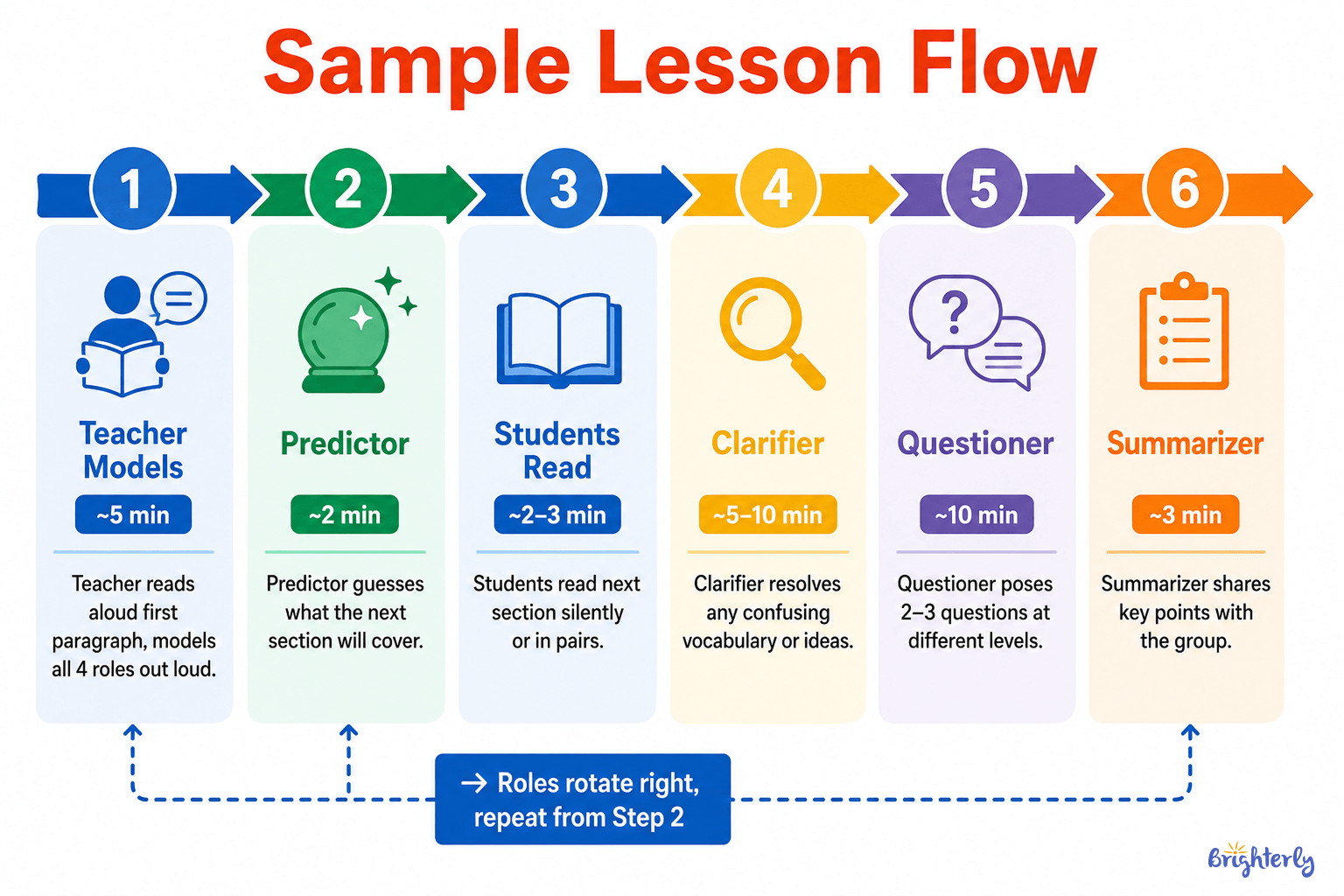
A Sample Reciprocal Teaching Lesson Flow
Here’s how a short reciprocal teaching lesson plan might look with a nonfiction passage for 4th grade reading practice about how sea turtles return to the beach where they were born.
| Step | Time | Teacher / Student Action | What Students Might Say |
| 1. Preview the text | 5 mins | Show the kids the title, headings, and one image from the passage. At this stage, students look for clues about the topic before reading. | Predictor: “I predict this passage will explain how sea turtles know where to go.” |
| 2. Read the first section | 2-3 mins | Students read the first short section either silently or with a partner. Here, the teacher needs to pause and not intervene. | Questioner: “What is one reason sea turtles travel long distances?” |
| 3. Clarify tricky words or ideas | 5-10 min | The clarifier leads the group to find the tricky words and ideas, or long and unclear sentences. Remind them to use context clues. | Clarifier: “The confusing word is ‘migration.’ From context, it probably means moving from one place to another.” |
| 4. Discuss a deeper question | 10 min | The group needs to answer one question that requires inference and deduction. They use parts of the passage to support their answer. | Questioner: “Why might beach lights make it harder for baby turtles to reach the ocean?” |
| 5. Summarize the section | 3-5 min | The summarizer here explains the main idea in their own words. The teacher checks that the summary is short and that students use their own words. | Summarizer: “This section explains that sea turtles use natural clues, like light and location, to find their way.” |
| 6. Rotate roles and continue | 2 min | Students switch roles before reading the next section. The teacher gives less help during the next section. | New Predictor: “I think the next part will explain what people can do to protect turtles.” |
Common Mistakes to Avoid
The idea of reciprocal teaching is quite simple, and the setup can be quick, too. However, if you are not careful, you might make these common mistakes that make the strategy less effective.
- Talking to much as a teacher. You should model and guide, especially as the kids are new to the strategy, but you shouldn’t lead the conversation, and you shouldn’t over-clarify the material for them.
- Skipping the modeling phase. Often, teachers explain the strategy and the roles briefly, without giving any reciprocal teaching examples. Students need to see how each role sounds.
- Not rotating roles consistently. Make sure that in the groups, each student ends up having all of the roles at least once.
- Accepting copied summaries. Kids need to learn to express what they read in their own words.
- Using the strategy only for fiction. Reciprocal teaching can be used for both narrative and informative and scientific texts.
“The BIG mistake many teachers make is TALKING about the content of the passage with their students instead of teaching how to make meaning from ANY text.”
Conclusion
Reading comprehension is a skill that needs to be developed, and reciprocal teaching treats it as such. By rotating through the roles, the strategy will become part of their natural reading process. The research behind the method shows that, as students who once read passively start asking better questions, catching their own confusion, and summarizing with precision.
If your students need more guided practice with understanding the reciprocal teaching definition and the strategy behind it, Brighterly’s reading program can help them build these skills with personalized lessons with certified tutors.
Frequently Asked Questions
What Grade Levels Work Best for Reciprocal Teaching?
Reciprocal teaching works best for students who can already read short texts but need help understanding and discussing what they read. Grades K-3 to K-8 are when teachers commonly use this strategy, but you can also adapt it to younger kids through shorter passages or using more pictures.
How Is Reciprocal Teaching Different from Cooperative Learning?
Cooperative learning means students work together, but reciprocal teaching gives that group work a very specific reading structure. While they still work together, in reciprocal teaching, each student has a role, so their discussions stay focused on text comprehension instead of becoming a general group activity.
How Does Reciprocal Teaching Help Struggling Readers?
Reciprocal reading brings large chunks of the text into small steps. Instead of trying to understand the whole text at once, your child needs to learn to pause, ask questions, fix confusing parts, and explain the main idea in their own words. According to the original research by Palincsar and Brown (1984), the strategy proved effective both for struggling and minority students.
How Long Does It Take Students to Learn the Four Roles?
While understanding the reciprocal teaching meaning and each role can be quick in theory, most students may need several guided sessions to feel natural in all four roles. The timeline will depend on the students’ age, their reading level, and how often they practice.
Can Parents Use Reciprocal Teaching at Home?
Yes, you can use reciprocal teaching at some point. If you have enough people to fill all four roles, do that. Alternatively, you can use a simpler form of the strategy. For example, while reading with your child, pause and ask them questions, modeling the roles. You can also do it together, with each of you having two roles for each passage.
Is Reciprocal Teaching Only for Reading Class?
No, reciprocal teaching can support reading in many subjects. Students can use the same four roles with science articles, history passages, biographies, and even different math word problems. Most texts can benefit from the skills reciprocal teaching develops.



Lessons on Preply may cost from $3 to $40+ per hour, depending on the tutors who set their rates individually and independently. Before consenting to Preply’s subscription model, find out what it entails, how you can adjust it, which benefits (and risks) it grants, what free and discounted options are available, and how Preply compares […]

Jun 03, 2026
Russian School of Math offers a rigorous, advanced curriculum, but its group format and structured pace may not suit every student. Brighterly is good for families looking for personalized 1:1 math tutoring with flexible scheduling and support adapted to the child’s level. AoPS and Think Academy are stronger matches for competition-focused learners, while Mathnasium, Kumon, […]

Jun 03, 2026
Math & reading from 1st to 12th grade
Looking for homework support for your child?

Choose kid's grade

Math & Reading for Grades 1–12
Build real confidence for your child with a Brighterly math or reading tutor.