CogAT Test Guide: Format, Scores, and Prep Tips for Parents
reviewed by Pinky Dumaguing
Updated on November 20, 2026
Key Points:
- The CogAT test measures verbal, quantitative, and nonverbal reasoning in K-12 students (Riverside Insights, 2025).
- CogAT Form 7 and CogAT Form 8 are equivalent — they use the same scoring system and can be used interchangeably (Riverside Insights, 2025).
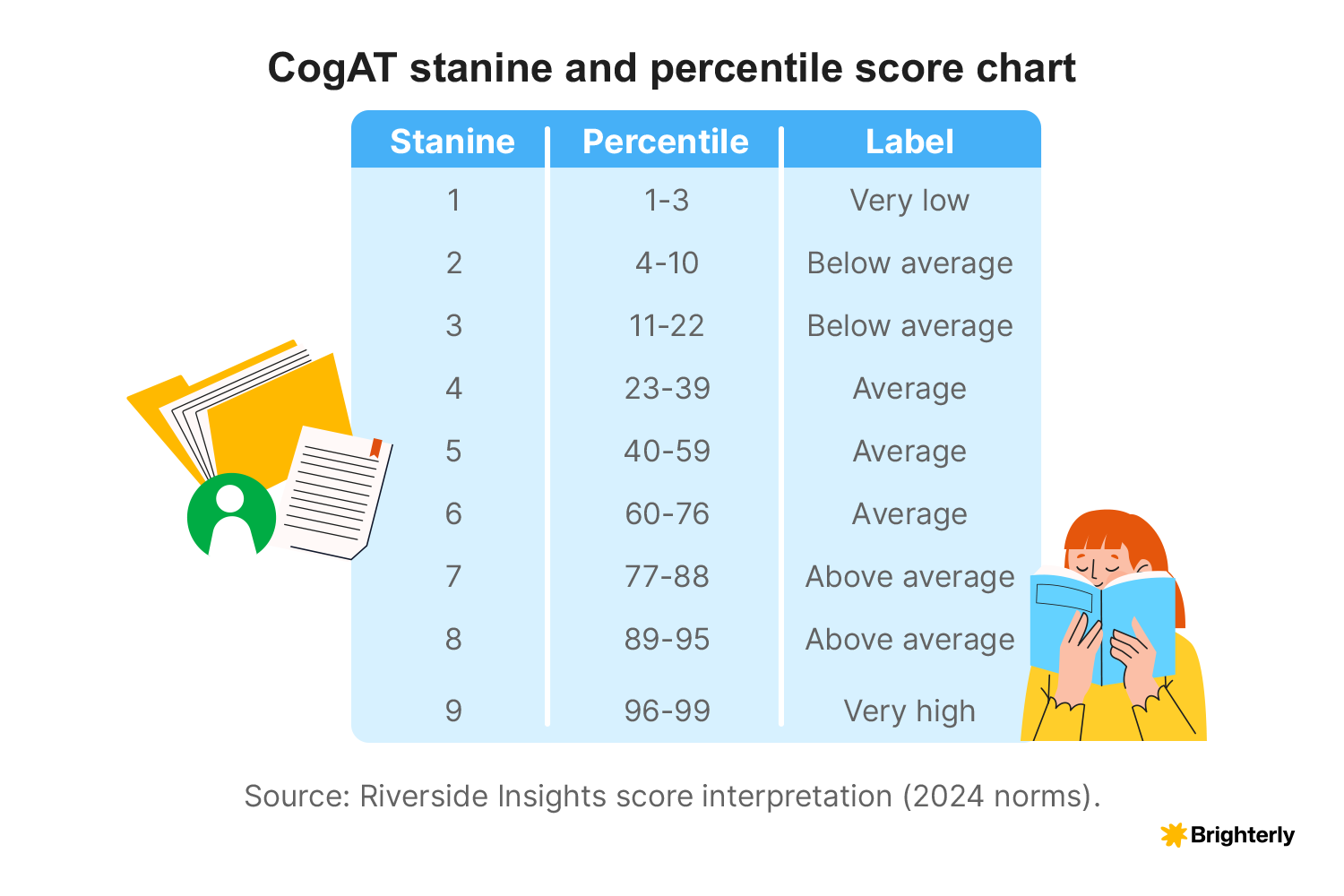
- CogAT results include a Standard Age Score (SAS), an age percentile rank, and a stanine.
- Since there’s no passing or failing the test, relaxed practice is better than cramming.
If your child’s school mentioned students are going to take the CogAT test, find out what this test means, what its format and levels are, how to help your child prepare for it, and how to interpret the test results.
What Is the CogAT Test?
The Cognitive Abilities Test (CogAT) is a group reasoning test by Riverside Insights for students in grades K-12 that measures how well children can actually solve new problems using words, numbers, and shapes, rather than measuring what children have simply memorized.
Some schools use the CogAT test as a universal screening tool, often to identify students for gifted and talented programs — the Colorado Department of Education includes the test in its 2024 assessment matrix for gifted student identification, for example.
Schools use either CogAT Form 7 or CogAT Form 8 — equivalent forms with the same score scales according to the Riverside Insights 2025 guide.
Before your child takes CogAT, ask their school about the test:
- Level: for which grades
- Form: CogAT Form 7 or CogAT Form 8
- Batteries: verbal, quantitative, nonverbal
- Mode: online or offline
- Date of the test


Is your child ready for CogAT?
Brighterly helps identify where a child stands and which skills need improvement.
Explore Brighterly Learning Experience
Learn exactly how Brighterly helps students thrive through expert sessions, online tools, and proven feedback from thousands of satisfied parents
CogAT Test Format: 3 Batteries and 9 Question Types
The CogAT test has nine question types divided into three sections (batteries): verbal, quantitative, and nonverbal. The verbal battery focuses on word relationships, the quantitative battery — on number patterns, and the nonverbal battery — on shapes.
| Battery | Question types | What a child does |
| Verbal |
|
Finds word or picture relationships, completes sentences, picks the item that fits a group |
| Quantitative |
|
Finds number relationships, balances equations or picture “trains”, continues a pattern |
| Nonverbal |
|
Completes a shape analogy, predicts holes after folding and punching, finds the shape that fits a group |
Source: Riverside Insights, 2025
CogAT Levels by Grade
| Grade | Level | Questions | Time |
| K | 5/6 | 118 | About 112 min, untimed |
| 1 | 7 | 136 | About 107 min, untimed |
| 2 | 8 | 156 | About 122 min, untimed |
| 3 | 9 | 170 | 90 min |
| 4–6 | 10–12 | 176 | 90 min |
| 7–8 | 13/14 | 176 | 90 min |
| 9–10 | 15/16 | 176 | 90 min |
| 11–12 | 17/18 | 176 | 90 min |
Source: Riverside Insights, 2025
CogAT Test Kindergarten: What Level 5/6 Looks Like
Level 5/6 offers kindergarteners 118 picture questions — no reading involved. There’s no time limit, but kindergarteners usually spend around 112 minutes on this level test. Riverside Insights 2025 guide recommends doing one subtest per battery per session.
How Are CogAT Scores Calculated?
To calculate CogAT scores, Riverside Insights takes the raw score (number of questions a kid got right) and looks it up in their norms tables to generate the test report for each battery.
The report with test results includes three things:
- Standard Age Score (SAS): a normalized score from 50 to 160 (with an average of 100) that shows the level and pace of a child’s reasoning development compared to other children of the exact same age
- Age percentile rank: a 1–99 score that shows the percentage of children of the same age who scored the same as or lower than the child
- Stanine: a simple 1-to-9 scale (with an average of 5) that groups a child’s results into broad performance levels compared to kids of the same age.
The report also includes a composite score for all three batteries and an ability profile, which looks like 7C (V+ Q–), for example. The number shows the general score level, the letter — score pattern, and plus or minus signs — specific strengths or weaknesses. In this example, “Q–” means number reasoning is an area where a kid needs to work more.
CogAT Scores by Age: What Is a Good Score?
A good CogAT score depends on your goal — SAS of over 128 (or Stanine 7-9) is usually desirable if you aim for a Gifted and Talented program, for example. In general, since the CogAT uses age norms/grade norms, the scoring scale is the same across all ages, which means a 130 score means the same thing for a kindergartener as it does for a high schooler.
What CogAT Score Qualifies for Gifted Programs?
The CogAT score that qualifies for gifted programs depends on the school district you’re in, but the 92nd–97th percentile or higher is the result that’s usually expected.
See our guide on signs your child may be gifted for more context.
*In case the quantitative battery score is high, our math enrichment program can help preserve and develop related skills. If not, our one-on-one online math tutor can help build necessary skills in small steps.
How to Prepare for the CogAT Test
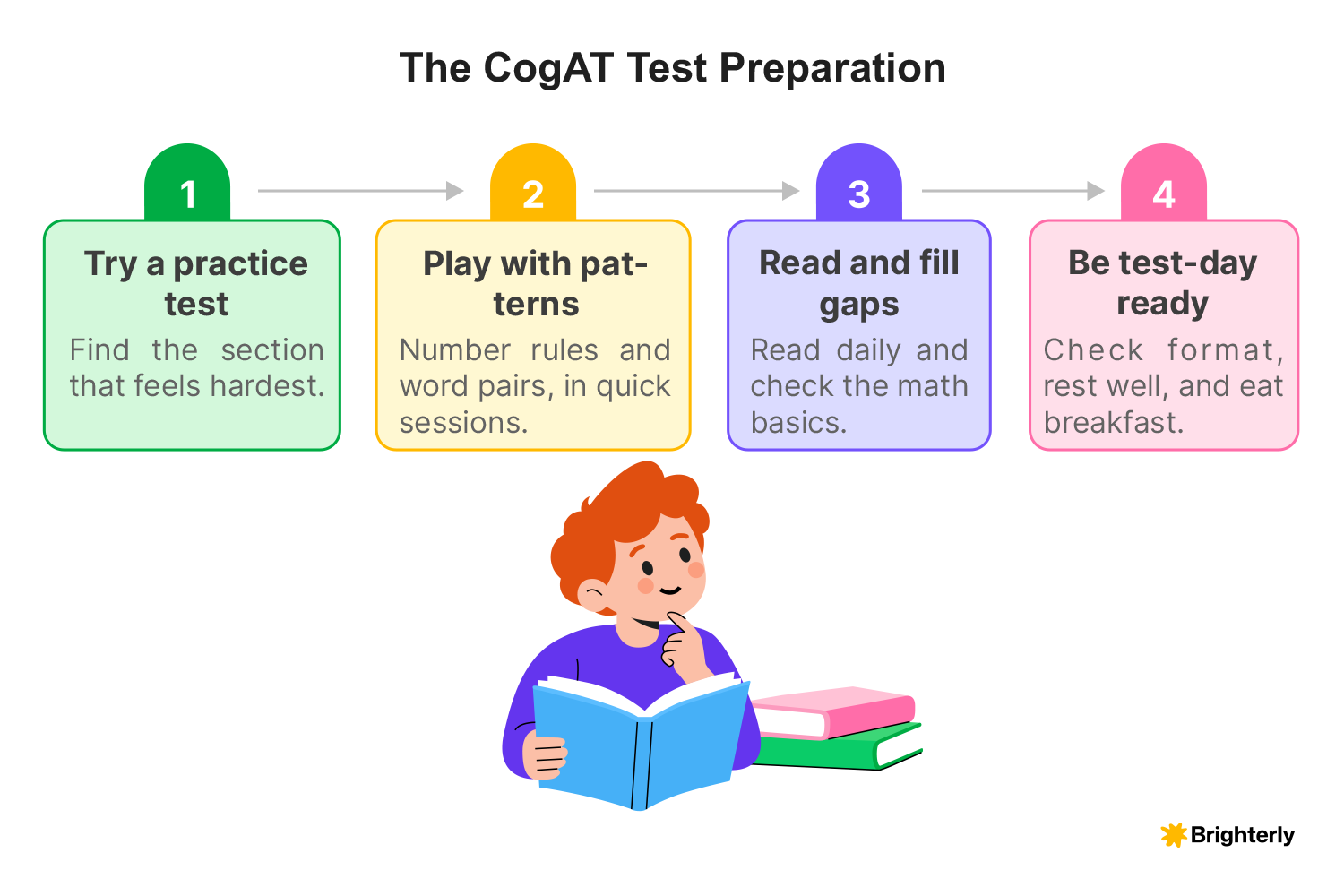
To prepare for the CogAT test, keep preparation sessions short, since short but calm and consistent practice is better than cramming. Also, take a practice test and confirm the test mode with your child’s school before the actual test.
Take a CogAT Practice Test to Find a Starting Point
Start with a short practice test or sample questions at your child’s level to see which battery feels the hardest. Riverside Insights offers schools free Practice Activities for preparation — ask your child’s teacher whether your school has them.
Practice Reasoning in Short Sessions
The CogAT is all about reasoning (how your child spots patterns, connects ideas, and solves new problems), so keep practice short and playful. For example, using math riddles for kids to find rules in number patterns can help build quantitative reasoning for the number series section, while talking through how word pairs relate can help develop verbal reasoning for analogies section.
Additionally, daily reading or an online reading program can give your child the vocabulary to make verbal connections, while a free diagnostic math test on our website can help spot basic number gaps so our tutor can fix them so that the child can focus on the actual reasoning behind each question.
Get Ready for Test Day
Verify with the school if they have finalized the testing mode (online or offline) so that the child’s first use of the device doesn’t suddenly happen on the test day. Also, make sure your kid gets a good sleep the night before the test and has a good breakfast the day of the test. Finally, telling a kid it’s impossible to fail the test lowers test anxiety.
Build reasoning skills with a tutor
Brighterly educators teach kids to spot patterns, connect ideas, and solve new problems.
CogAT vs. NNAT (Naglieri) vs. OLSAT: How Gifted Tests Compare
The main difference between CogAT, NNAT, and OLSAT tests comes down to the skills they measure, their length, and their question formats. The NNAT3 is a quick, 30-minute visual screening that relies strictly on shapes and patterns with no language or math involved. In contrast, the OLSAT 8 is a much longer, 75-minute exam that tests a broader mix of verbal, nonverbal, and quantitative skills.
The CogAT also covers those same three areas, but uses completely unique puzzle formats, meaning an NNAT practice test or an OLSAT practice test will not prepare your child for the CogAT.
| Test | Publisher | Sections | Grades | Typical use |
| CogAT | Riverside Insights | Verbal, quantitative, nonverbal | K–12 | Gifted screening, instruction |
| NNAT3 (Naglieri) | Pearson | Nonverbal | K–12 | General-ability screening |
| OLSAT 8 | Pearson | Verbal, nonverbal, quantitative | K–12 | General ability |
CogAT vs. MAP
The main difference between the CogAT and the NWEA MAP (Measure of Academic Progress) test is that the former measures learning potential while the latter measures actual academic achievement. In other words, while CogAT evaluates how a student learns, MAP evaluates what a student has already actually learned.
Conclusion
The CogAT test shows how your child learns instead of how they recall. Before your student takes the test, figure out which level and form they’re taking, keep practice sessions short, and when you get the results, look at them as a snapshot of your child’s strengths.
If you need personalized support, address a professional tutor to achieve the desirable results.
Frequently Asked Questions
Is the CogAT an IQ Test?
No, even though the CogAT measures similar reasoning skills, it’s not an official IQ test. The CogAT is a school test students take in groups, while an IQ test is taken by one person at a time and is administered by a trained psychologist or clinician.
Can a Child Fail the CogAT?
No, it’s not possible for a child to fail or pass the CogAT — its results simply show how your child compares to the students of the same age in terms of how they learn.
Can My Child Retake the CogAT?
Yes, a child may retake the CogAT, but it depends on your child’s school policy. In general, the Riverside Insights 2025 guide recommends waiting 3 to 6 months before retaking the test.
Does the CogAT Affect School Grades?
No, the CogAT doesn’t affect school grades — teachers use it to understand how a student learns best, identify areas where a student needs support, and see if a student is eligible for gifted and talented programs or advanced placement tracks.

MAP test practice can help your child feel more confident on test day. This guide provides sample MAP questions with answers and explanations, a simple 4-week prep plan, and links to further MAP growth test practice. MAP Growth at a Glance Explore Brighterly Learning Experience Learn exactly how Brighterly helps students thrive through expert sessions, […]
Nov 20, 2026
Math & reading from 1st to 12th grade
Looking for homework support for your child?

Choose kid's grade

Math & Reading for Grades 1–12
Build real confidence for your child with a Brighterly math or reading tutor.