MAP Test Practice: Free Sample Questions by Grade (K–12)
reviewed by Susan Bangloy Palacio
Updated on November 20, 2026
Key Points:
- MAP test practice isn’t something kids need to study for. Prep means getting comfortable with the online format and practicing grade-level skills. (as of November 2026, per NWEA).
- The NWEA MAP test (MAP Growth) is an adaptive online assessment. Prep with MAP-style questions, like the free samples offered on this page.
- NWEA offers a free official practice test for learning the layout and tools. Brighterly provides additional online math programs and grade-level tests to build math and reading skills.
MAP test practice can help your child feel more confident on test day. This guide provides sample MAP questions with answers and explanations, a simple 4-week prep plan, and links to further MAP growth test practice.
Note: This guide covers the NWEA MAP Growth test, not Missouri’s state MAP test
MAP Growth at a Glance
| Test maker | NWEA (Northwest Evaluation Association) |
| Grades | K-12 |
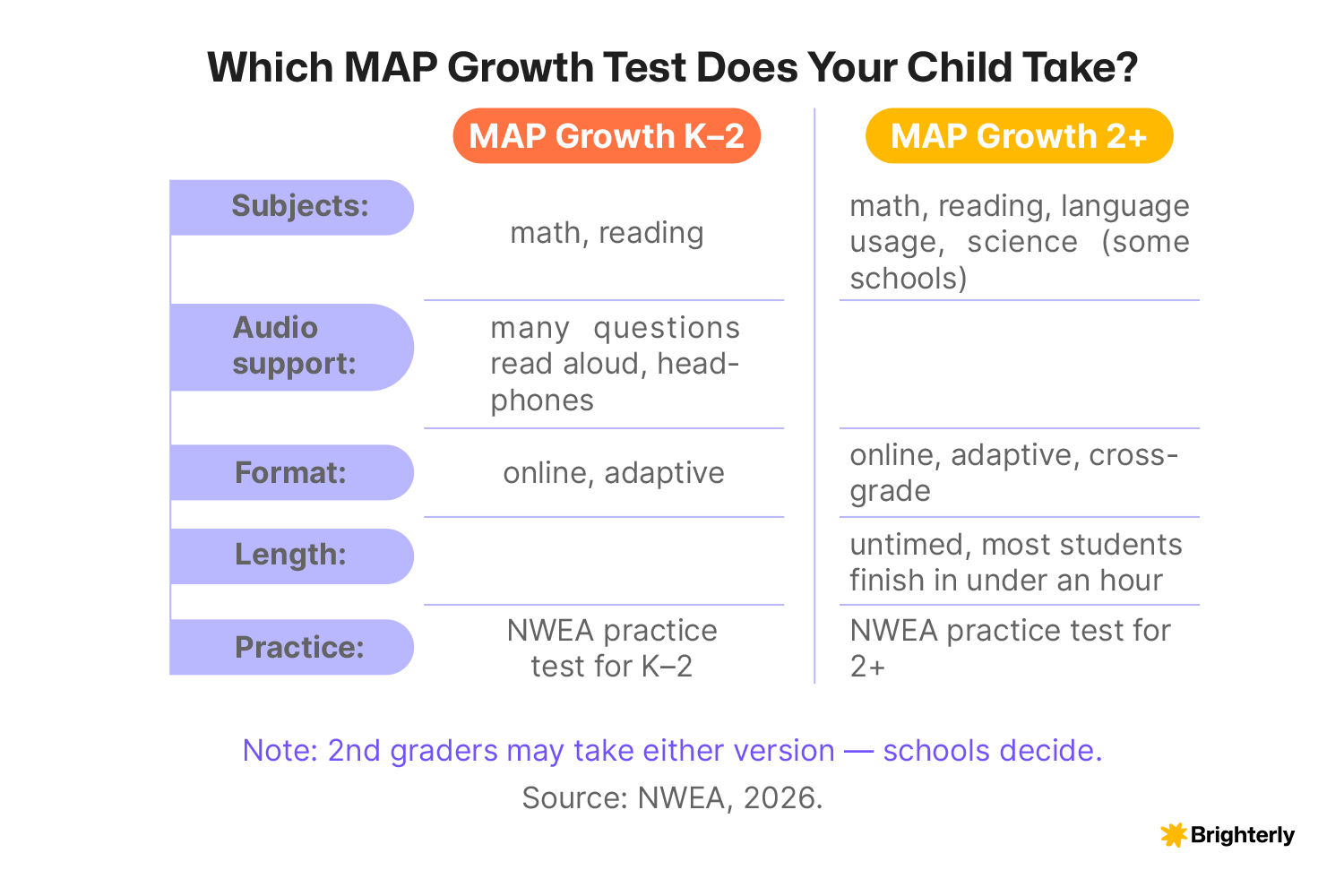
| Subjects | Math and reading (K-12); language usage (grades 2-12); science (grades 2-12) |
| Format | Online, computer-adaptive test. |
| Audio | K-2: Many questions include built-in audio. |
| Length | Untimed. NWEA says most students finish in under an hour. |
| How often | 3 times a year (beginning, middle, and end of the school year) |
| Scoring | RIT scale and student percentiles |
|
Pass/fail |
None |
Source: NWEA FAQs (correct as of November 2026.)
Explore Brighterly Learning Experience
Learn exactly how Brighterly helps students thrive through expert sessions, online tools, and proven feedback from thousands of satisfied parents
Free MAP Test Practice Questions by Grade
These are MAP Growth practice test questions, not real NWEA test questions. To prep effectively, encourage your child to:
- Read the question and all of the options before answering
- Recheck their math answers
- Don’t panic if it’s too hard, have a go, and move on
Note: For more information on MAP scores, check out our MAP scores guide.
Kindergarten – 2nd Grade Sample Questions
The K-2 MAP test questions target reading and math skills for K-2. Questions are adaptive, so they get progressively more difficult.
Question 1 (math):
Noah has 8 toy cars. He gives his friend Mia 3. How many toy cars does Noah have left?
- A. 11
- B. 5
- C. 2
- D. 9
Answer: B
Why: This is a subtraction word problem. First, convert the word problem into a sum and then solve (8 – 3 = 5)
Skill tested: Solving one-step subtraction word problems (K-1 math)
Question 2 (reading):
Olivia and her brother went to the shops to buy snacks, then they went to the park and played catch. Afterward, they shared snacks on a bench.
Where did they play catch?
- A. At school
- B. In their backyard
- C. At the park
- D. At a friend’s house
Answer: C
Why: The story states that they played catch in the park.
Skill tested: Retrieving information from a short passage (Grade 1 reading comprehension)
Note: On the real K-2 test, many questions are read aloud through headphones.
For more grade-appropriate practice, use our free reading tests for 1st and 2nd grade.


Worried your child’s math isn’t at grade level?
Our tutors build a personalized plan to help them reach their goal.
3rd–5th Grade Sample Questions
The MAP test for 3rd to 5th graders covers math, reading, language, and science skills. Some schools advanced 2nd and 5th graders to take the test at a higher level.
Question 1 (math):
Dillon wants to buy some pens. Each pen costs $3, and he has a total of $21. What is the maximum number of pens Dillon can buy?
- A. 5
- B. 6
- C. 7
- D. 8
Answer: C
Why: Divide the total (21) by the cost per pen (3): 21 ÷ 3 = 7.
Skill tested: Operations and algebraic thinking (Grade 3)
Question 2 (reading):
Bees play an important role in helping plants grow. As bees move from flower to flower, they carry pollen between plants. This process, called pollination, helps many plants produce fruits and seeds.
What does the word pollination mean in the passage?
Options:
- A. The process of watering plants
- B. The movement of pollen between flowers
- C. The process of growing roots
- D. The collection of seeds from plants
Answer: B
Why: The passage explains that pollination is the movement of pollen between flowers.
Skill tested: Determining word meaning from context clues (Grade 4).
Question 3 (language usage):
Which sentence uses correct subject-verb agreement?
Options:
- A. The dogs runs across the yard.
- B. The dog run across the yard.
- C. The dogs run across the yard.
- D. The dogs running across the yard.
Answer: C
Why: The subject “dogs” is plural, so it needs the plural verb “run.”
Skill tested: Using correct subject-verb agreement in complete sentences (Grade 3)
For extra practice, try our free 3rd grade reading tests, 4th grade reading tests, or 5th grade reading tests.
6th–8th Grade Sample Questions
Question 1 (math):
A school has 200 students. If 35% of the students participate in the school band, how many students are in the band?
Options:
- A. 30
- B. 40
- C. 60
- D. 70
Answer: D
Why: To find 35% of 200, multiply 200 by 0.35 (200 × 0.35 = 70).
Skill tested: Word problems using percentages (Grade 6)
Question 2 (reading):
Community gardens benefit neighborhoods in several ways. They give residents a place to grow fruits and vegetables and can also bring neighbors together and encourage teamwork. In some communities, gardens even help make unused land look prettier.
What is the central idea of the passage?
Options:
- A. Community gardens are difficult to maintain.
- B. Community gardens provide several benefits to neighborhoods.
- C. All communities must have a community garden.
- D. The sole purpose of a community garden is to look pretty.
Answer: B
Why: The passage describes several advantages of community gardens, which support the central idea.
Skill tested: Identifying the central idea of a short passage (Reading comprehension Grade 7).
Question 3 (language usage):
Which of the following sentences uses commas correctly?
Options:
- A. Before we left, we ate lunch.
- B. Before, we left we ate lunch.
- C. Before we left we ate, lunch.
- D. Before we, left, we ate lunch.
Answer: A
Why: The introductory clause “Before we left” is followed by a comma to separate it from the main clause.
Skill tested: Using commas correctly (Grade 7).
Before taking the NWEA MAP test, you can use grade-specific reading tests like our free reading tests for 6th graders, 7th graders, and 8th graders to help you get ready.
9th–12th Grade Sample Questions
Question 1 (math):
A taxi company charges a starting fee of $5 plus $2 for every mile traveled. The total cost is represented by the equation y=2x+5, where x is the number of miles and y is the total cost in dollars.
What does the slope of the equation represent?
Options:
- A. The starting fee of $5
- B. The cost of $2 per mile
- C. The total cost of a 5-mile trip
- D. The number of miles traveled
Answer: B
Why: The slope is the coefficient of x, which is 2. This means the taxi fare increases by $2 for every additional mile traveled.
Skill tested: Interpreting the slope of a linear function in a real-world context (High School)
Question 2 (reading):
Public libraries deserve community support because they provide more than just books. They offer free internet access, educational programs, and quiet spaces for study. Investing in libraries makes learning resources available to everyone.
What is the author’s main purpose in this passage?
Options:
- A. To explain that libraries provide books
- B. To persuade readers that public libraries deserve community support
- C. To describe what public libraries are used for
- D. To argue against investing in libraries
Answer: B
Why: The author presents the argument that libraries should be supported by communities.
Skill tested: Analyzing a point of view (Grade 9–10).
For further high school level reading practice, try our 9th grade, 10th grade, 11th grade, and 12th grade reading tests.
Where to Find More Free MAP Growth Test Practice
NWEA offers a free, non-adaptive MAP assessment practice test that is short and has no final score. However, the practice test helps kids understand the test format and learn how to use the online tools.
To access the NWEA practice test, follow these steps:
- Access here
- Select ‘practice test’
- Log in with the username and password (The NWEA provides a generic login and password)
- Select the right grade and subject
Note: For a fuller grade-level check, our free math and reading tests by grade show which skills your child has mastered and what needs more practice.
Free Practice by Grade
Students can use the free NWEA MAP Growth practice tests to become familiar with the assessment format, and Brighterly’s grade-level tests for deeper practice.
| Grade | NWEA practice test (as of November 2026) | Brighterly’s free reading tests | Best for |
| K-2 | NWEA K-2 test | Early math skills, number recognition, being comfortable with online testing | |
| 3-5 | NWEA 2+ test | Multiplication, division, fractions, word problems | |
| 6-8 | NWEA 2+ test | Ratios, percentages, geometry, pre-algebra | |
| 9-12 | NWEA 2+ test | Algebra, functions, high-school math concepts |
The MAP test is a progress monitoring tool, not a pass/fail test. The best way to prepare kids is to make sure they know how to navigate online testing and practice grade-appropriate skills.
How to Prepare for the MAP Test: A 4-Week Plan
MAP test prep should include understanding the format and short, regular skill practice. Here’s how to prep your kid:
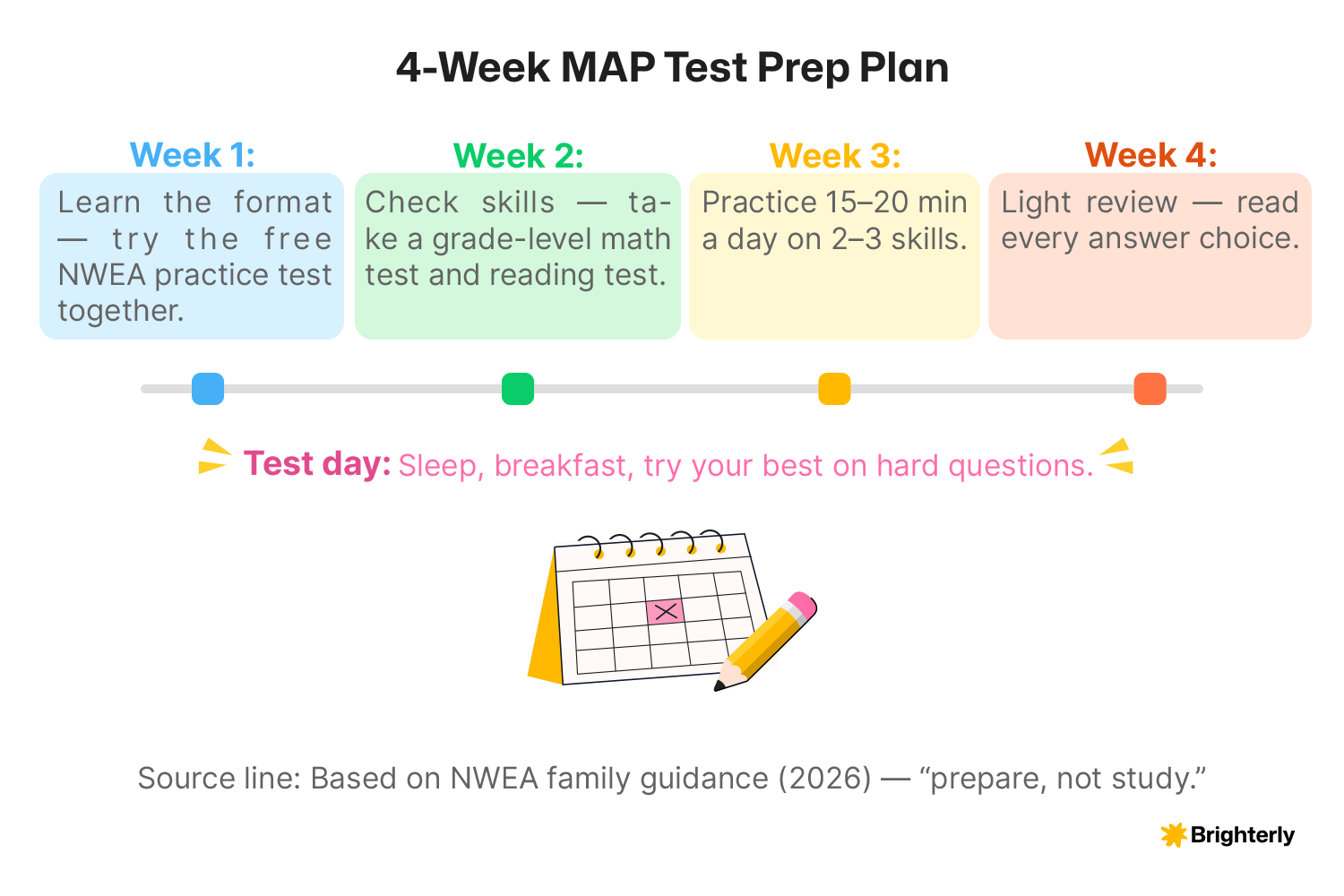
Note: For more structured MAP testing practice, our 1:1 math tutors create personalized lessons targeting the skills your child needs to strengthen based on practice test results.
Prepping for the MAP Growth test?
Figure out what skills your kid needs to practice before the test
Conclusion
Prep for the MAP Growth test in short, regular sessions. Use the official MAP practice test to learn how the test works and sample questions like those above to practice grade-appropriate math and reading skills.
For more help, book our free demo lessons and let your kid practice with specialized tutors.
Frequently Asked Questions
Can Kids Study for the MAP Test?
Yes, but the NWEA prefers that kids prepare, not study. To do this, learn the test format and practice the auditory questions (K-2). You can also take general grade-related math and reading practice tests to build skills and spot weaknesses.
Can a Student Fail the MAP Growth Test?
No, you cannot fail the MAP test. The test measures academic growth, so schools can look out for learning gaps, kids who need extra support, or anyone who could benefit from enrichment programs.
Does the MAP Test Affect Report Card Grades?
Generally no, the MAP test is a measure of academic progress and helps teachers plan rather than a comment on daily performance. A child’s report card will reflect many areas including school tests and homework assignments, not just the MAP test.
Are Practice Questions the Same as Real MAP Test Questions?
No, practice questions are generally based on grade-level curriculums rather than exact test questions. In the real MAP test your kid answers questions above and below their grade level until the test finds the exact level they’re working at.
What Should My Child Do When a MAP Question Feels Too Hard?
The most important thing is to not panic, the test is designed to give harder questions until it finds the right level. So, make sure your kid expects this and advise them to read every question and answer fully before making a choice.
NWEA® and MAP® Growth™ are trademarks of NWEA. Brighterly is not affiliated with or endorsed by NWEA.

A Brighterly analysis of five years of Google search data and the Nation’s Report Card finds the struggle peaks in middle school, and families are looking for help, not just answers. US math scores sit below pre-pandemic levels, and families are turning to Google for help. This Brighterly report combines five years of Google search […]

Nov 20, 2026
If your child’s school mentioned students are going to take the CogAT test, find out what this test means, what its format and levels are, how to help your child prepare for it, and how to interpret the test results. What Is the CogAT Test? The Cognitive Abilities Test (CogAT) is a group reasoning test […]
Nov 20, 2026
Math & reading from 1st to 12th grade
Looking for homework support for your child?

Choose kid's grade

Math & Reading for Grades 1–12
Build real confidence for your child with a Brighterly math or reading tutor.