Your High School Summer Reading List: 30+ Must-Read Books for 2026
reviewed by Franz Jerby Delos Santos
Updated on July 27, 2026
Key Points: A summer break sounds good, but long periods without reading cause a big summer setback. If you want to prevent a “brain drain” and keep your reading skills sharp, this curated reading list for high school students will help.
A reading plan designed to keep you engaged.
Brighterly helps to find joy in reading, even in summer.
An optimal summer reading list for high school mixes classics, contemporary fiction, memoir, and nonfiction, and at least one book that high school students pick themselves. The plan below helps plan your summer reading and avoid summer slide. These remarkable titles are standard picks for high school reading and are sure to get you ready for classroom discussions of literary classics. Name & Author Short Description To Kill a Mockingbird — Harper Lee To Kill a Mockingbird is a 1960 Southern Gothic novel by American author Harper Lee. Young Scout Finch watches her father defend a Black man who was falsely accused of a crime, forcing readers to see how bias forms in the community. Wuthering Heights — Emily Brontë Wuthering Heights is a 1847 novel by English author Emily Brontë. The book follows the turbulent relationship between Catherine and Heathcliff, set on the wild, windswept Yorkshire Moors. 1984 — George Orwell Nineteen Eighty-Four is a 1949 dystopian novel by the English writer George Orwell. Set in a totalitarian state called Oceania, this novel is about control, surveillance, and political manipulation. The Great Gatsby — F. Scott Fitzgerald The Great Gatsby was first published in 1925. This novel perfectly depicts the Roaring 20s and explores themes of chasing the American Dream. Lord of the Flies — William Golding Lord of the Flies is a 1954 novel set on an uninhabited island. It follows a stranded group of boys as they try to replicate a societal structure. The novel themes involve morality and leadership. If you want a modern high school reading list to add to your plan, these ones are genuinely well-written and popular among students your age. So by the end of summer, you’ll have something to talk about and improve reading skills. Name & Author Short Description We Should All Be Feminists — Chimamanda Ngozi Adichie This book-length essay, published in 2014, presents a definition of feminism in the 21st century. We Should All Be Feminists explores themes of sexuality, appearance, roles, and success. The Perks of Being a Wallflower — Stephen Chbosky This 1999 novel is about a 9th-grader navigating high school and building his first real friendships. Students who feel like oddballs will find this book especially interesting. The Hate U Give — Angie Thomas The Hate U Give follows Starr Carter, who witnesses a white police officer shoot and kill her childhood friend, Khalil. The novel explores themes of justice and doesn’t simplify moral questions for a younger audience. The Poet X — Elizabeth Acevedo The Poet X follows a 15-year-old Xiomara as she navigates conflicts in her family through poetry. Through her writing, students explore themes of patriarchy, sexism, and objectification of young women. Mexican Gothic — Silvia Moreno-Garcia Mexican Gothic is a 2020 gothic horror. The novel is one of the popular books for high schoolers and follows a young woman who’s investigating her cousin’s accusations about her husband’s intention to murder her. 11th and 12th grade is the right moment to read it. This section confuses high school students — teen reading is mostly fiction. However, college-level reading is largely nonfiction, so getting used to it now will make the transition easier. Name & Author Short Description An American Childhood – Annie Dillard An American Childhood is a 1987 memoir that takes place in Pittsburgh in the 1950s and 1960s. The memoir describes how America was recovering from World War II — Dillard paints an affectionate look at her adolescent years. Atomic Habits — James Clear Atomic Habits is a 2018 self-help book that can be especially helpful for reluctant readers. The book talks about how to build habits that stick — students enjoy practical tools that help them build a system to achieve their goals. A People’s History of the United States — Howard Zinn American history from a perspective of people who were left out of the standard textbook version: Indigenous people, enslaved people, women, and immigrants. This book allows students to look critically at the “traditional” history they learn in school. Money Out Loud: All the Financial Stuff No One Taught Us — Berna Anat Schools don’t teach financial literacy. Berna Anat helps young adults figure out budgeting and the struggles of capitalist society. It features illustrations and workbooks so teens can get down to business right away. Hidden Systems: Water, Electricity, the Internet, and the Secrets Behind the Systems We Use Every Day — Dan Nott Dan Nott gives teens a peek at how hidden systems work. If you’ve ever wondered how water, electricity, and the internet reach your home, this book is for you. People often think that graphic novels are not “real reading”. This is a misconception — some graphic novels present complex narratives and help with understanding text structures. Graphic novels for high school students explore layered stories and nuanced themes. Name & Author Short Description Maus — Art Spiegelman Maus’ story revolves around Spiegelman interviewing his father about the atrocities he lived through as a Polish Jew in Auschwitz. He renders the story with Jews as mice and Nazis as cats. Maus is a Pulitzer Prize winner and is regularly assigned as one of the novels for high school students and in college courses. Persepolis — Marjane Satrapi Persepolis is a series of graphic novels about Marjane Satrapi’s childhood in Iran after the Islamic Revolution. This novel is one of the best introductions to Iranian history and culture for American high school students. March trilogy — John Lewis The March trilogy is a black-and-white graphic memoir that tells the story of the Civil Rights Movement through the eyes of civil rights leader and U.S. Congressman John Lewis. Students who pair it with the To Kill a Mockingbird get a very different historical perspective. Explore Brighterly Learning Experience Learn exactly how Brighterly helps students thrive through expert sessions, online tools, and proven feedback from thousands of satisfied parents Reading in each grade in high school is not the same. To start, not all high schoolers are at the same level. A freshman is still improving vocabulary and attention span, while a senior is ready to tackle analytical, sustained reading. High school summer reading list for grades 9–10 is all about developing the ability to stick with longer books, form reading habits, and find enjoyment in reading. Title Genre The Book Thief – Markus Zusak Coming-of-age, finction A Wrinkle in Time — Madeleine L’Engle Science fantasy, adventure The House on Mango Street – Sandra Cisneros Coming-of-age, fiction Night — Elie Wiesel Memoir, Holocaust literature The Absolutely True Diary of a Part-Time Indian — Sherman Alexie Coming-of-age, contemporary fiction Speak — Laurie Halse Anderson YA fiction, coming-of-age A Long Way Gone – Ishmael Beah Memoir, war literature The Curious Incident of the Dog in the Night-Time – Mark Haddon Mystery, contemporary fiction The Maze Runner — James Dashner Dystopian Fiction, science fiction, adventure The Lightning Thief — Rick Riordan Fantasy, adventure, mythology The Fault in Our Stars – John Green YA fiction, romance, contemporary fiction The Book of Unknown Americans — Cristina Henríquez Contemporary fiction, immigration literature By 11th grade, students are ready for more complex themes. Teens need to be reading books that challenge them: unfamiliar perspectives and long nonfiction. College is around the corner, so it’s the right time to build analytical engagement through high school summer reading books. Title Genre Pride and Prejudice — Jane Austen Classic fiction, romance Brave New World – Aldous Huxley Dystopian fiction, science Fiction The Catcher in the Rye — J. D. Salinger Coming-of-age, fiction Their Eyes Were Watching God — Zora Neale Hurston Historical fiction The Handmaid’s Tale – Margaret Atwood Dystopian fiction, speculative fiction A Separate Peace — John Knowles Coming-of-age, historical fiction The Road – Cormac McCarthy Post-apocalyptic fiction, literary Fiction Frankenstein — Mary Shelley Gothic fiction, science fiction Jane Eyre – Charlotte Brontë Gothic fiction, romance The Picture of Dorian Gray — Oscar Wilde Gothic fiction, philosophical fiction Gone with the Wind – Margaret Mitchell Historical fiction, romance, epic fiction Americanah — Chimamanda Ngozi Adichie Contemporary fiction, social commentary
Great minds start at Brighterly.
Get reading lessons and keep the summer slide under control.
Summer reading matters for high school students because it prevents summer learning loss and keeps reading skills sharp. According to the National Bureau of Economic Research (NBER) randomized study, students who read over the summer write stronger college essays, have a larger vocabulary, and preserve skills they built over the school year. This is why summer reading programs are so popular. Summer slide is the loss of academic skills during the summer break. Teenagers are highly affected by it — according to a 2025 report from Harvard’s Center for Education Policy Research and Stanford’s Center for Education Policy Analysis, the average student was nearly half a grade level behind pre-pandemic achievement levels in reading and math. To make the most of your summer reading, mix formal high school summer reading lists with books of your choice. This approach reduces reading fatigue and helps students stay motivated. Another way to make the most of your summer reading is to join a Brighterly summer reading camp. We offer live 1:1 sessions with a reading tutor who supports summer reading for high school students. Take a diagnostic reading test, and explore where your child stands before the new school year begins. Yes. Choosing their own summer reading books is ok, and it’s probably better. A book they choose and finish builds more interest and stamina than a book they’re assigned through summer reading books in high school. The best genres for a high school summer reading list depend on what the student is interested in. The rule of thumb is: one literary classic, one contemporary fiction title, one nonfiction book, and a title the student wants to read. Yes. The SAT reading section tests the students’ ability to read complex texts, so reading during the summer helps improve the critical thinking needed for SAT and ACT prep. Students who read over the summer find the SAT reading section less intimidating. To get reluctant readers to read over the summer, don’t push classics right away. Start with YA fiction — The Perks of Being a Wallflower, The Hate U Give, and The Poet X are usually the titles that high school students finish in two or three sittings. Then, you can move to some complex literature. Yes. Most public libraries run free summer reading programs for high school students. You can visit your local library to explore annual summer reading lists. For students who need structured support, a Brighterly reading tutor can provide a reading list, plus targeted lessons to address specific reading challenges. Phonics apps help children connect letters with sounds and develop essential blending and decoding skills through interactive lessons, games, and videos. For learners who need personalized guidance, Brighterly combines live one-on-one phonics tutoring with digital tools that help families review each lesson. This guide compares the best phonics apps and learning platforms based on their […] Jul 07, 2026 When picking between Mathnasium vs Brighterly, you probably ask what your child benefits more from in learning: a structured and collaboration within a small group or a tutor’s full attention and support. This guide covers why they are different, how Brighterly may suit anxious students, and how Mathnasium may offer more for collaborative learning. Mathnasium […] Jul 13, 2026
High School Summer Reading List 2026
Classic Literature Every High Schooler Should Read
Contemporary Fiction and YA Fiction
Nonfiction, Memoir, and Self-Development
Graphic Novels for High School Readers
Summer Reading List by Grade: What to Read and When
Books for Freshmen and Sophomores (Grades 9–10)
Books for Juniors and Seniors (Grades 11–12)
Why Summer Reading Matters for High School Students
What Is the Summer Slide and How Does It Affect Teens?
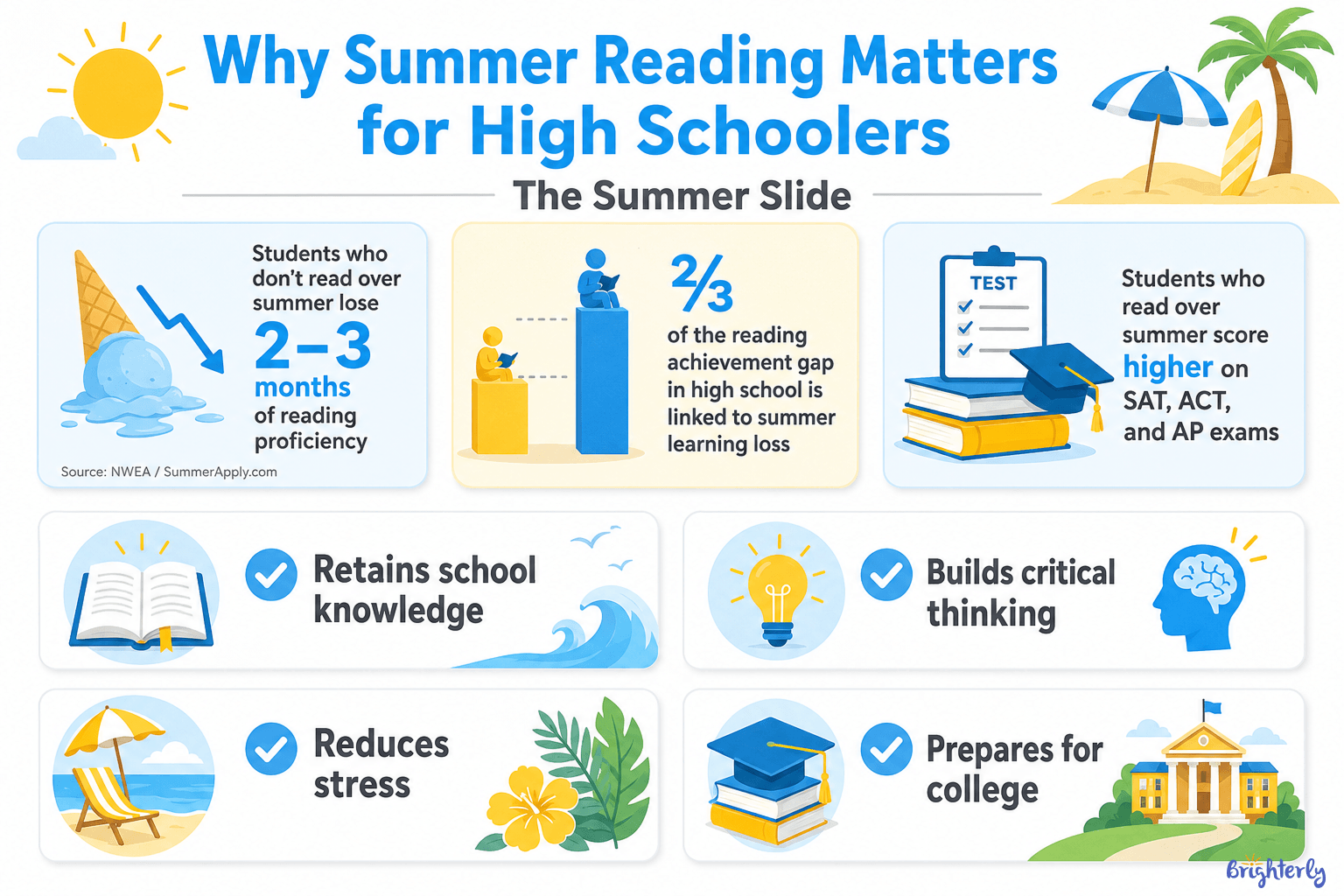
Benefits of Summer Reading for High Schoolers
How to Make the Most of Your Summer Reading
We tailor sessions based on individual reading needs with real-time personalized feedback. Our reading comprehension program allows your teen to work on their knowledge gaps and choose literature they have a genuine interest in.Frequently Asked Questions
Is It OK for High Schoolers to Choose Their Own Summer Reading Books?
What Are the Best Genres for a High School Summer Reading List?
Can Summer Reading Help High Schoolers Prepare for the SAT or ACT?
How Do Parents Get Reluctant Teen Readers to Read Over Summer?
Are There Free Summer Reading Programs for High School Students?



Math & reading from 1st to 12th grade
Looking for homework support for your child?
Choose kid's grade

Math & Reading for Grades 1–12
Build real confidence for your child with a Brighterly math or reading tutor.