How to Explain ADHD to a Child in a Simple and Supportive Way
reviewed by Janice S. Armas
Updated on September 15, 2026
Key Points:
- Explain ADHD to kids once they are diagnosed; it will prevent the buildup of shame.
- Describe ADHD as a brain that’s just wired differently and never describe it as “broken ” or “bad.”
- Pick a simple analogy, personalize the explanation, and consider the words so the explanation sticks in kids’ minds.
- End every conversation with the next steps and the plan on how you can support them.
- According to the CDC (2026), from 58% to 80% of kids with an ADHD diagnosis across the U.S. receive treatment in the form of behavioral therapy or medication.
Your child may have just gotten an ADHD diagnosis. And you wonder how to explain ADHD to a child and not scare them? The main principle is to frame ADHD correctly and avoid using words that imply that something is wrong. This guide underlines that plain words, analogies, and scripts matter and help kids maintain confidence.
Should You Tell Your Child They Have ADHD?
Yes, you should tell your child they have attention deficit hyperactivity disorder (ADHD) in an age-appropriate explanation. It prevents them from believing that they are “bad” or “flawed.” When you explain that their brain is just different, it provides relief, helps them accept themselves, and helps them understand why some tasks and activities need support.
The main benefits of such a move are:
- Lowering shame. An open conversation about ADHD for kids replaces a vague sense of “something is wrong with me” with a decent explanation.
- Adding to self-awareness. Children better understand the ADHD brain and the patterns of inattention, hyperactivity, or impulsivity.
- Helping with self-advocation. A kid will feel more at ease asking a teacher for a movement break and won’t get in trouble for it.
Note: The best time to tell your child about their ADHD is as soon as they are diagnosed and can understand you, ideally between ages 6 and 8.
Explore Brighterly Learning Experience
Learn exactly how Brighterly helps students thrive through expert sessions, online tools, and proven feedback from thousands of satisfied parents
How to Explain ADHD to a Child: A Step-by-Step Guide
To explain ADHD to a child, a parent should choose the right time, begin with what the child already knows, and use plain and understandable language, cover all the angles, both strengths and tricky parts, and close with a plan of action and reassurances.
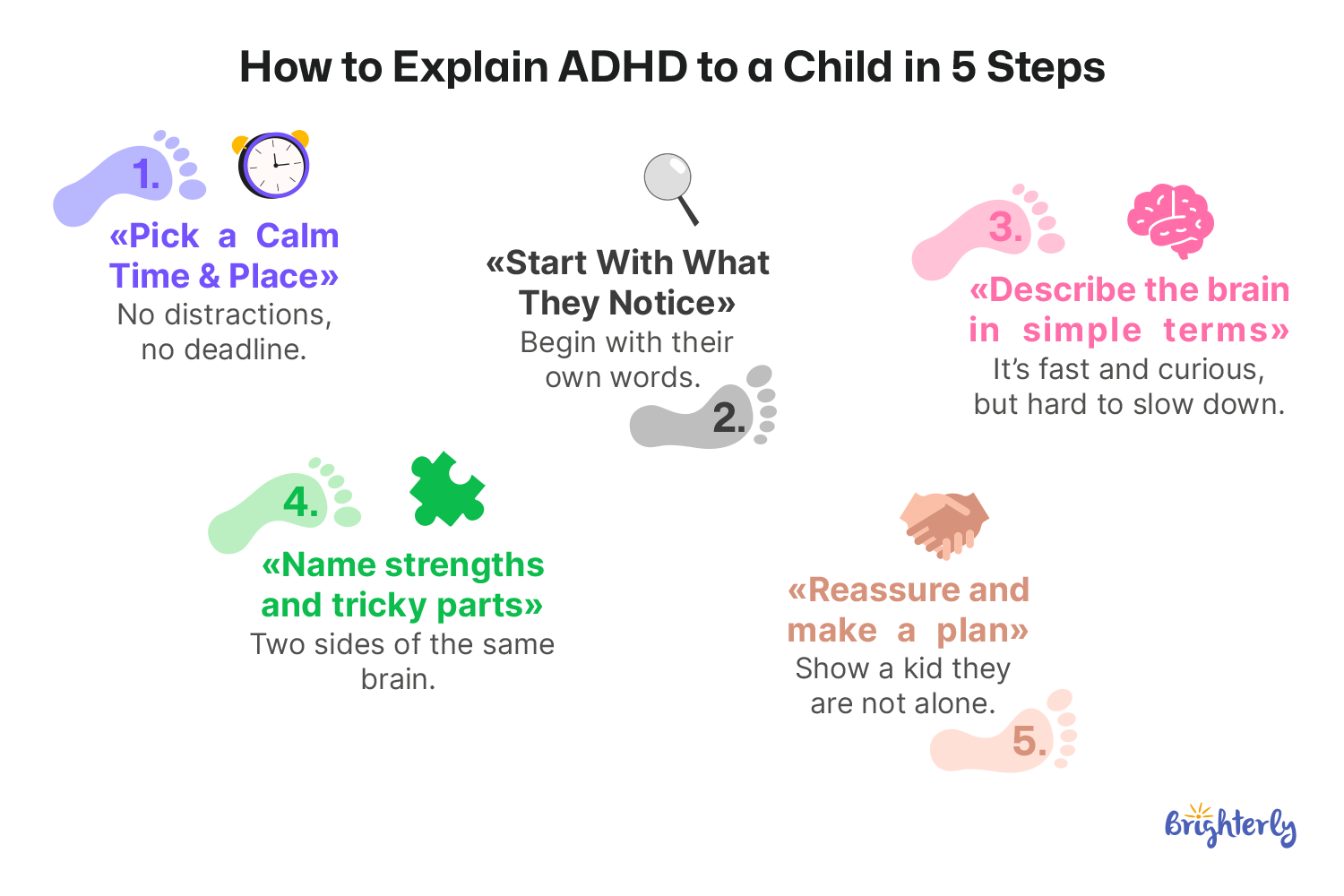
Note. Understanding how to talk to kids about ADHD is about a general approach and a certain order that ensures clarity, not solely the right words.
Step #1: Pick a Calm Time and Place
First of all, you should find a relaxed time that has no pressure on the kid. Ensure there is no audience or deadline for such a communication. A car ride, a walk, or bedtime would be better than a formal sit-down.
There, try to make the conversation open and honest, just as Kate Moryoussef, a global expert in ADHD wellbeing, suggests:
“When a child feels seen, heard, validated, and deeply accepted, with love, compassion, and curiosity, a beautiful conversation can begin to help them let go of any voice of self-criticism and shame.”


Step #2: Start With What They Already Notice
Next, your goal is to start, but do it smoothly. That’s why it’s important to begin with something they have already felt and can relate to. It will help them avoid the feeling of being blamed or ambushed by something new.
A good example of how you can start is:
“You recently told me that it’s hard for you to sit during independent reading sessions. I want/can share why that happens.”


Help your kid close reading or math gaps
Our personalized tutors customize plans to the specific learning needs
Step #3: Describe the ADHD Brain in Simple Words
The center, or the heart of the “how to describe ADHD” approach, lies in words you’d choose to make the explanation concrete, to the point, and physical.
For instance, to describe the processes of the brain, you can say something like this: “Your brain is fast and curious, and has so many ideas, but it can be hard to slow down or switch tasks, something called executive function.”
In any case, avoid placing in the center such words as “disorder” or “deficit.” They attract judgment rather than facts. Instead, personalize explanations.
Dr. Caroline Danda, a licensed child psychologist, shares her example of how to describe ADHD appropriately.
“You know how sometimes it’s hard to remember directions, shift gears, or calm big feelings? There’s a reason for that. It’s called ADHD.”

Step #4. Name Their Strengths and Their Tricky Parts
Next, a kid needs to understand both strengths and challenges. For a kid, a great way to understand is to get that they come from the same wiring, one brain that has two sides.
It’s a matter of how you frame it. So, pair each challenge with a strength and use storytelling. That way, you will be able to balance the conversation and avoid focusing on the problems. In particular, when talking about creativity and hyperfocus, don’t forget about trouble waiting or remembering multi-step directions.
Susan Gingras Fitzell, Neurodiversity expert, underlines that such an approach is important when shifting a narrative from a negative label:
“When explaining ADHD, we must shift the narrative from a negative label to a strategy-based mindset.”
I encourage parents to explain the traits causing school struggles. For example, high energy and unorthodox ways of thinking are the same traits shared by brilliant creators like Thomas Edison.
Tell your child, 'Your brain is wired for intense creativity and energy. Sometimes that makes sitting still hard, but it gives you incredible potential once we discover how you learn best.' When a child realizes their brain simply processes the world differently, their internal voice changes from feeling broken to becoming a self-regulated strategist.

Step #5. Reassure Them and Make a Plan Together
After the explanation happens, it’s important to close the conversation, but make it positive and actionable. You can close with words like: “You’re not alone, and we’re going to figure this out.”
Make sure you offer a concrete next step or direction after it. It may be a new routine, a chat with a specialist or teachers, or a certain appointment.
Note: If you’re looking for how to support studying with your ADHD kid, be sure to check this guide.
How to Explain ADHD to a Child by Age
How you explain ADHD to a child should reflect the child’s specific needs, their age, and stage of development. Since each kid is different, your explanation should reflect it. For instance, a 7-old kid may need one explanation, and a 10-year-old kid a different one.
|
Age |
How Much To Say |
Words and Analogies That May Work |
What They May Worry About |
|
Ages 4-6 |
Short sentences, explain gently when it comes up |
Race car analogy, where the brain is a race car that’s fast and fun, but it’s important to know how to use the brakes. |
Is there trouble? Is there something bad I did? |
|
Ages 7-9 |
Short but honest conversation with clear takeaway |
“Many brains work differently; you just need different tools” |
Why can’t I do the things the same as my friends? |
|
Ages 10-12 |
More details, a clear definition of ADHD, and what it means for them every day |
Comparing or pairing challenges and strengths, naming them as parts of ADHD. |
Will others treat me differently because of the condition? |
|
Ages 13+ (teens) |
Make it more direct, in a more adult-style manner, inviting questions. |
Use deeper explanations like “ADHD affects executive function:…” |
Will it limit my future or independence? |
Here’s an excerpt that Jessica Covington, a holistic ADHD coach, shares with parents who aim to explain an ADHD diagnosis to their kids:
“Every person has a unique learning style, and lots of us have parts in common. They're all DIFFERENT, and they're all GOOD!”
Having so many different learning styles in the world is cool because we can team up to help each other, and borrow each other's strengths to grow and learn.
The most important thing is to KNOW our thinking style because it helps us get the right tools and strategies for our brain.

Simple Analogies to Explain ADHD to Kids
When explaining ADHD to kids, a good analogy is worth paragraphs of explanations. The simplest analogies refer to the concepts and objects the kids recognize and understand, and know how they work, including a race car, a browser, or a highway.
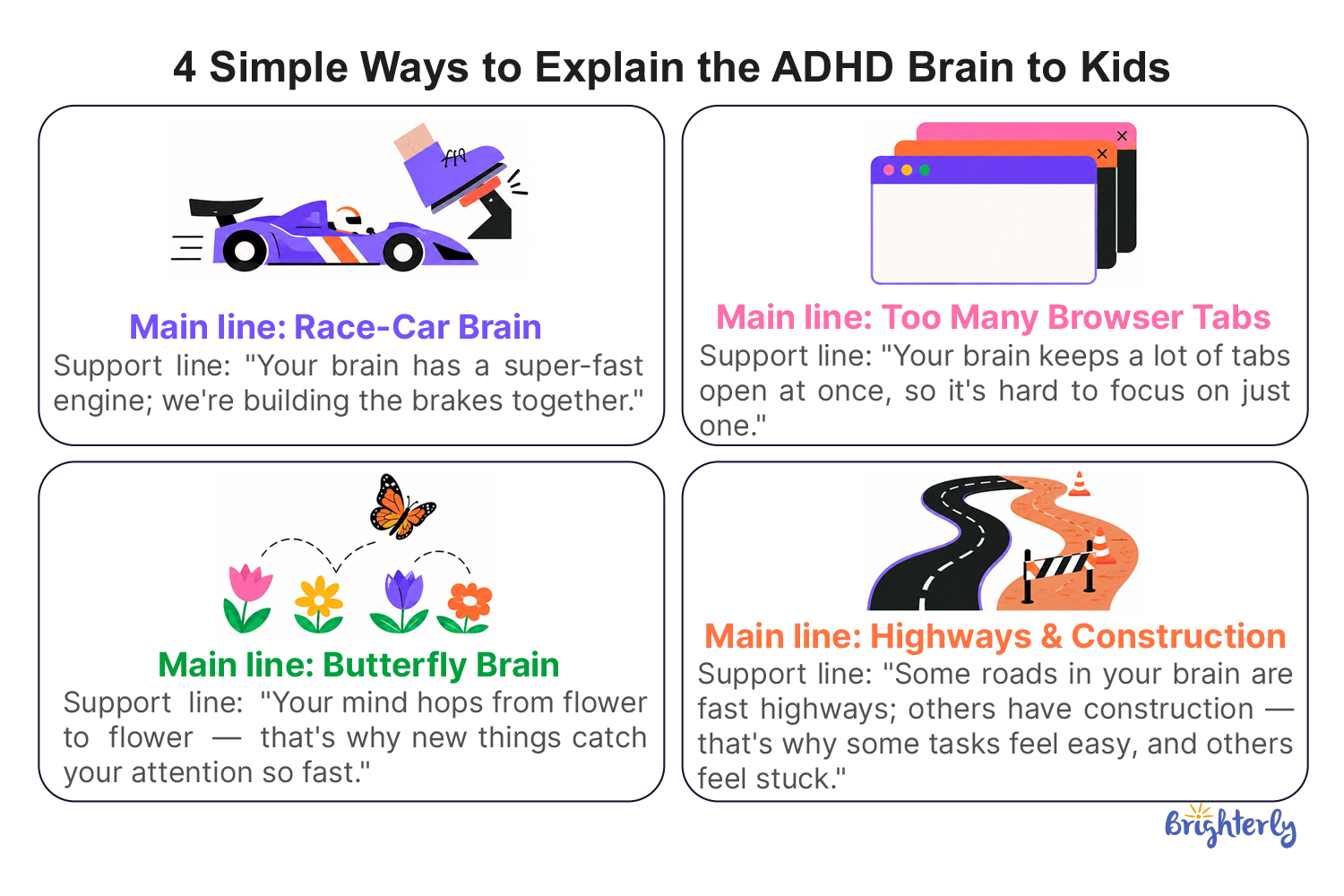
Here are 5 analogies that parents and specialists use to have ADHD explained for kids:
- Race car brain with bicycle brakes. You can compare a brain to a super-fast engine, and underline that you build brakes together for it.
- A browser with too many tabs open. It’s another analogy that explains why it may be hard to focus on just one point or matter.
- A butterfly brain. It implies how butterflies get from one flower to another. That way, you say, “your mind gets from flower to flower, so new things get your attention so fast”.
- Highways and construction. With it, you can compare some parts of the brain to the roads. On highways, the tasks are easy, while in zones of construction, the kid may get stuck.
- A flipping remote controller. This one implies that the brain flips channels, and that’s why you should practice holding the remote steady together.
Note: Remember that ADHD isn’t a rare issue. For an in-depth look into it, please check this guide.
What to Say and What Not to Say
Language and words may shape how they will remember the information and feel about it. Thus, it is crucial to avoid shame and blame words, do your best to resist any desire to over-explain things or use jargon, and never frame ADHD as an excuse for certain behavior.
|
✅ Say This |
❌ Skip This |
|
“Your brain works differently; it’s not bad, it’s just how your brain wired differently; that’s just how it works” |
“There’s a thing that’s wrong.” “Something is wrong with you” |
|
“Lots of kids have ADHD, and you are not the only one” |
“Everyone has a focus struggle sometimes” (as it minimizes the real experience of a child) |
|
“This will help you understand why some things are harder, and it’s not an excuse; it’s a thing to know” |
“You shouldn’t use ADHD as an excuse” |
|
“We’ll find and use tools and routines that will work for your brain” |
Jargon or specific ADHD symptoms in children that clinical specialists may use in books. |
Here’s what Sophie Schauermann, co-founder and therapist of Rooted Rhythm, says about the things that you should avoid:
“Avoid phrases that imply something is wrong with them, like “You can’t control yourself” or “Something’s wrong with your brain.”

Answering Your Child’s Common Questions About ADHD
Answering common questions about ADHD allows you to reframe challenges without making the condition feel like a flaw. In this regard, answering their questions requires you to use simple language and reassuring analogies, normalize their feelings, and de-escalate negative emotions.
Here are some common questions, and you can answer them:
- “Did I do something wrong?” – No, it’s something you were born with. You didn’t cause it. It’s just how your brain works and manages attention, not how good or bad you are.
- “Will it go away? Or will I have it forever?” – For many people, kids and adults, ADHD changes as they grow; they get tools that help to make things easier.
- “Do I have to take medicine?” – Some people use medicine; others use tools. That’s a decision for you, your parents, and your doctor to make.
- “Am I different from everyone else?” – Every brain is different in its own way. You just have a name for some of these differences, and it helps to get the right tools and support.
- “Why do I keep forgetting stuff?” – It’s not because you aren’t trying; it’s just how your brain works. That’s why we use tools such as checklists, for instance.
Note. According to a CDC post (2026), across the US states, from 58% to 80% of children with ADHD receive a specific treatment, either behavioral therapy or medication.
How to Support Your Child at Home and School
To support your kid at school, you should think of asking for accommodations (within the IEP or 504 plan), maintaining communication with teachers, and encouraging movement during breaks.
At home, you can try to develop homework routines and visual schedules, and set up a workspace. Besides, you can resort to specific reading strategies for children with ADHD as well as ways to improve their math confidence.
One more effective way to support a kid is to use online personalized learning options, like Brighterly. Many families resort to it to provide academic support, close gaps, and simply improve confidence.
At Brighterly, we provide 1:1 sessions built around customized learning plans that adapt to specific learning needs and goals and support learning via interactions.
- For instance, our professional math teachers make learning engaging and fun and integrate movement breaks into the classes.
- To provide math help for ADHD students, our tutors focus on homework routines, habits, understanding, and learning pace.
- For reading and writing tutoring, we consider the child’s attention span, pace, and foundational skills so that they proceed gradually.
Support your kids’ learning
We customize learning to the kids’ specific needs
Final Thoughts
Starting an honest and kind conversation about ADHD provides certain benefits. It builds children’s confidence and helps them gain the confidence to speak for themselves. If you start the conversation with the right words and at the right time, you’ll motivate them to learn coping strategies and manage ADHD in the future.
Frequently Asked Questions
How Long Should My First Conversation About ADHD Be?
As a parent, your first conversation about ADHD with your child should be 5-10 minutes. It should be brief and casual, as heavy and long talk can cause anxiety. Instead, you can view the first conversation as the initial point of many short conversations that will come in the upcoming months and years.
Should I Explain ADHD to My Child Before or After the Diagnosis is Confirmed?
You should explain the idea of brain differences before the assessment, yet you should wait until the diagnosis is confirmed to use the label ADHD. Such a way to explain ADHD comes from the idea that when kids are informed, they feel safe and included. If nothing is said at all, kids can feel confused or broken.
How Do I Explain My Child’s ADHD to Their Brothers and Sisters?
You can follow a similar approach that you are to use to explain ADHD, in particular, explaining how the brain works and what the ADHD brain is. In this regard, you can use analogies and focus on the idea that there’s nothing wrong with it. Also, underline that they should differentiate between a reason and an excuse.
Are There Good Books or Videos That Explain ADHD to Kids?
Yes, there are enough “what is ADHD for kids” resources that can help explain it in an engaging and friendly way to kids. You can find an ADHD video for kids on YouTube or resort to CADDAC’s Animated Kids Series. For books, you can use lists of stories and books like “All Dogs Have ADHD” by Kathy Hoopmann or “My Unique ADHD World” by Joanne Steer and Claire Berry.
Will Explaining ADHD Make My Child Use It as an Excuse?
No, explaining ADHD to a child can work the other way and help you prevent the child from using it as an excuse if you frame it as an explanation for challenges. Such a framing will allow you to give them reasons to advocate for themselves, remove shame, and motivate learning effective coping strategies.

Choosing between Revolution Prep vs Varsity Tutors vs Brighterly while looking for the best after school tutoring programs to support a child’s academic success is a challenging decision. Each offers personalized 1:1 tutoring sessions but differs in pricing, tutor expertise, teaching approach, and the range of subjects. This article compares each platform’s pros and cons, […]
Jul 28, 2026
The best math apps and web-based learning platforms for 3rd graders include Brighterly, Prodigy Math, SplashLearn, IXL Math, Khan Academy, Khan Academy Kids, Zearn, and DreamBox. Each serves a different purpose: Brighterly provides live 1:1 instruction, while other tools focus on self-paced practice, educational games, adaptive learning, video lessons, or a combination of digital and […]

Jul 29, 2026
Math & reading from 1st to 12th grade
Looking for homework support for your child?

Choose kid's grade

Math & Reading for Grades 1–12
Build real confidence for your child with a Brighterly math or reading tutor.