Symbolism in Poetry: Definition and Examples
reviewed by Ella Jane Icawalo
Updated on August 13, 2026
Key Points:
- Symbolism in poetry is the use of an object, color, person, place, or action to represent a deeper idea or emotion beyond its literal meaning.
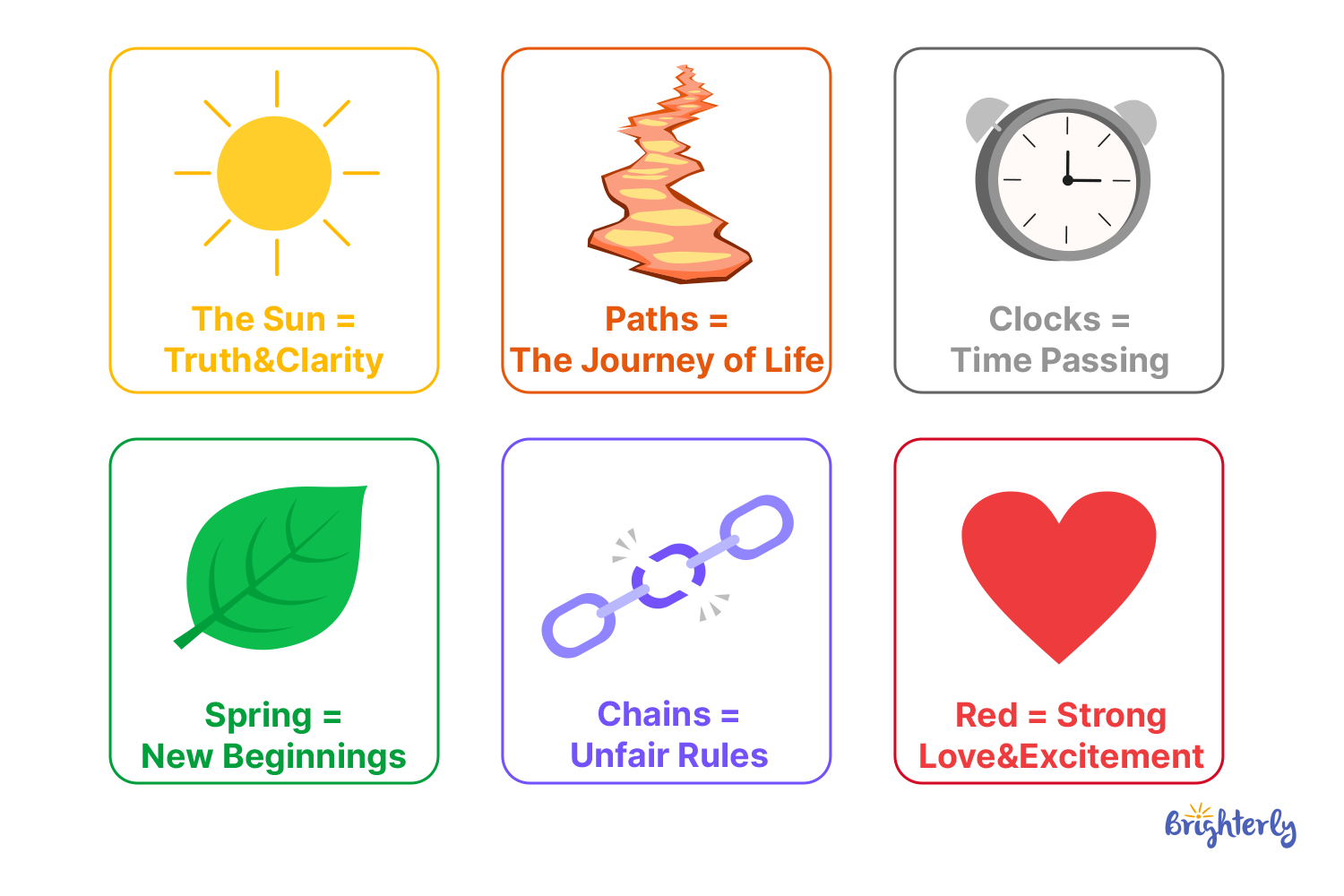
- Common poetic symbols include the sun for truth or clarity, birds for freedom, clocks for the passage of time, and red for love, anger, or danger.
- Famous poems use symbolism to communicate complex themes: for example, the caged bird in Maya Angelou’s Caged Bird represents confinement and the desire for freedom, while the roads in Robert Frost’s The Road Not Taken represent life choices.
- Children can learn to recognize symbolism by starting with familiar objects and colors, then practicing how those elements communicate feelings and ideas in poems. Brighterly’s ELA tutoring can help kids build these interpretation and literary analysis skills in personalized 1:1 lessons.
Symbolism in poetry gives ordinary objects, colors, people, or actions a deeper meaning. A bird can represent freedom, a road can symbolize a life choice, and spring can suggest a new beginning. Here, you’ll explore common poetry symbols, famous examples, and simple ways to teach symbolism to kids.
What Is Symbolism?
Symbolism in poetry is a literary device for employing a particular element – an object, color, person, or action – to represent an abstract value or emotion besides its literal meaning. The item stays real inside the story, although it also carries a secret message or shows the author’s main point.
An example of symbolism in poetry might appear as:
- A locked wooden chest symbolizes hidden memories or keeping a big secret.
- A roaring campfire – meaning excitement or a big feeling of anger.
- A deep green forest symbolizes growing up and living an active life.
- A spider spinning a web – standing for working patiently or how our choices connect.
- A ticking clock stands for growing older or waiting for something big to happen.
Help kids decode symbols in poetry
Brighterly’s personalized 1:1 reading lessons build interpretation skills through guided literary discussions. 

Explore Brighterly Learning Experience
Learn exactly how Brighterly helps students thrive through expert sessions, online tools, and proven feedback from thousands of satisfied parents
Common Symbols in Poetry and What They Mean
Nature Symbolism
- Stars
- Destiny, guidance, big goals, far-away wonders.
- The Sun
- Truth, learning, bright energy, life, clarity
- The Moon
- Mystery, gentle feelings, time passing, cycles, dreams.
- Rain
- Letting go of the old, sadness, release of emotions.
- Wind
- Change, unseen forces, inspiration, moving forward.
- Water
- Deep thoughts, beginning anew, the flow of time.
- Fire
- Anger, wild energy, excitement, strong power.
- Winter
- Rest, isolation, old age, stillness, emptiness.
- Spring
- Birth, renewal, youth, hope, new beginnings.
- Summer
- Growing up, high energy, excitement, the peak of life.
- Autumn
- Decline, aging, wisdom, harvesting, change.
Animals Poetic Symbols
- Birds
- Freedom, escaping trouble, the human spirit.
- Snakes
- Temptation, underlying risk, secrets.
- Owls
- Wisdom, silent observation, the mystique of the night.
- Lions
- Royalty, pride, courage, strong and natural power.
- Butterflies
- Growing up, changing for the better, how fragile and special life is.
Everyday Object Symbolism
- Paths and roads
- The journey of life, the personal choices we make, the unknown future.
- Clocks and hourglasses
- Growing older, the unstoppable passage of time, having little time left.
- Chains
- Being trapped, unfair rules, overwhelming worries, unbreakable bonds.
- Keys and doors
- Secrets, new opportunities, sparking new ideas.
- Mirrors
-
- Looking closely at yourself, seeing the truth, the line between what is real and what is pretend.
Color Symbolism
- Red
- Anger, strong love, excitement, danger.
- White
- Innocence, cleanliness, peace, safety, getting a fresh start.
- Black
- The unknown, sadness, mystery, the dark.
- Green
- Jealousy, nature, growing bigger, safety, healing.
- Blue
- Calm feelings, deep sadness, stability, truth.
Note: At Brighterly, we offer professional reading & writing help, starting at $17.70/lesson (2 lessons/week, 12-month plan, now 20% off). Our live 1:1 lessons can, in particular, explain how writers use rhythmic sound devices in poetry, expand your kids’ grasp of symbol definition in poetry, help them master figurative language, and teach types of poetry.
Examples of Symbolism in Poetry
1. Caged Bird by Maya Angelou
But a bird that stalks
Down his narrow cage
Can seldom see through
His bars of rage
His wings are clipped and
His feet are tied
So he opens his throat to sing.
The symbol – caged bird versus free bird – represents: The struggle between being trapped and being free. The caged bird portrays unfair rules and a lack of freedom, and the free bird means independence.
2. Ah! Sun-flower by William Blake
Ah Sun-flower! weary of time,
Who countest the steps of the Sun:
Seeking after that sweet golden clime
Where the travellers journey is done.
The symbol – sunflower – represents: People who are tired of difficult times and are looking for peace or hope. Given that a sunflower is rooted in the dirt yet turns its head to watch the sun, it shows someone always looking up to something greater.
3. The Road Not Taken by Robert Frost
Two roads diverged in a yellow wood,
And sorry I could not travel both
And be one traveler, long I stood…
The symbol – two diverging roads –represents: Important choices in life – the fork in the path means a moment of choosing one direction, knowing one can’t then try the other.
4. Hope is the thing with feathers by Emily Dickinson
‘Hope’ is the thing with feathers –
That perches in the soul –
And sings the tune without the words –
And never stops – at all –
The symbol – a small, singing bird – represents: The strength of human hope that, like a little bird, keeps singing its consoling song in one’s spirit to give them strength.
Symbolism vs Metaphor vs Imagery
| Definition | Purpose | Example | Clue | |
| Symbolism | The symbol definition poetry implies using an item to embody an abstract idea besides its literal meaning. | To embed layered and deeper meaning. | A character wears a heavy iron chain around their neck. | The real object has a hidden meaning of emotional burden. |
| Metaphor | A statement that one thing is another unrelated thing. | To explain something emotional by naming it with something familiar. | ‘The classroom was a zoo during the lesson.’ | Look for words equating two different things (is/was, are/were). |
| Imagery | Descriptive language that refers to sight, sound, smell, taste, and touch. | To match the tone, create a lively mental picture and draw the reader into the sensory experience. | ‘The crisp, amber leaves crunched under my heavy leather boots.’ | Look for picturesque adjectives and verbs that make you see, hear, feel, smell, or taste the scene. |
How to Teach Symbolism Poetry to Kids
The most effective approach to teaching symbolism to kids on your own is to start with particular items they see every day and gradually connect them to written language. For a more comprehensive dive into this creative genre in literature, consider our professional literature tutors who employ diverse literacy strategies and can enhance your kid’s abstract thinking and deeper reading.
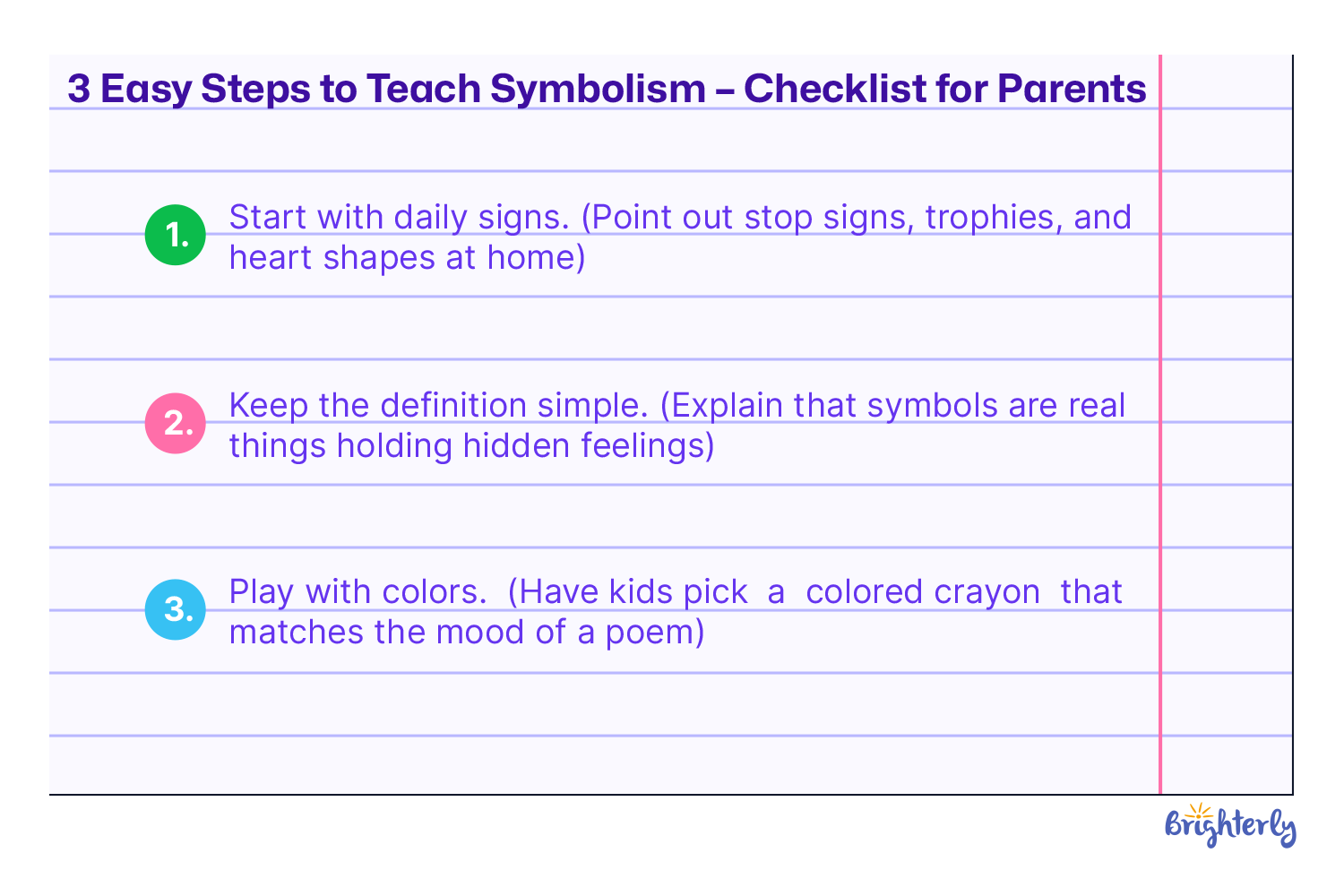
- Start with kids’ daily stuff. Before defining ‘What is a symbol in poetry?’, detect real instances:
- A bright yellow color often indicates happiness, while a dark gray cloud can mean sadness or trouble.
- A red octagon means stop, and a green light implies go.
- A trophy represents victory; a heart shape depicts love; a white flag symbolizes peace, etc.
- Provide a correct symbol poetry definition. State it clearly without complex jargon: Symbolism occurs when an author uses a physical object, color, or action to represent an idea that you cannot physically touch.
- For practice, focus on how kids choose objects to convey particular feelings or pick a colored crayon that matches the mood of the poem you read to them. You may also use our free printable reading worksheets that make abstract concepts visible.
- Proceed with reading comprehension strategies or consider our reading comprehension program for explicit inference training and contextual vocabulary development, one-on-one with a professional tutor at your kid’s pace.
Frequently Asked Questions
Why Do Poets Use Symbolism?
- To simplify language, yet still evoke a complex idea without using multiple sentences.
- To induce emotion, because referencing a cold, dark winter night triggers a much stronger feeling in a reader than the word ‘sadness.’
- To create layers of meaning, since a casual reader can enjoy the literal narrative and an analytical reader can uncover deeper thematic arguments.
How Do You Identify Poetry Symbols in a Poem?
- Watch for repetition, as the frequency indicates that an item carries thematic weight.
- Analyze key placement, since the maximum impact is usually in the title, the opening line, or the final stanza.
- Examine traditional associations, considering the universal cultural meanings already attached to the image.
At What Age Should Kids Learn Symbolism in Poetry?
According to the study by Adrian M. Gellel (an education researcher specializing in children’s symbolic and metaphorical thinking) published in Sage Journals in 2024, symbolic thinking can be nurtured in kids through appropriate instruction and examples:
- 5-7 yo – kids can recognize simple symbolic relationships
- 7-9 yo – ready to learn basic symbolism in poetry and stories
- 10-12 yo – usually analyze more complex symbols.
Can a Symbol Mean Different Things in Different Poems?
Yes, a symbol meaning in poetry depends on the surrounding text:
- A fire can represent domestic life, but if surrounded by words of destruction, it’ll indicate anger or ruin.
- A white dress symbolizes weddings in Western literature, yet in many Eastern cultures, white is the color of funerals.
- Although a nested bird represents safety, a poet can turn it into a symbol of confinement with themes of entrapment.
What’s the Difference Between a Symbol in Poetry and a Theme?
A symbol is a concrete object, person, color, or action that represents an abstract idea. A theme is the author’s message and overarching truth about human nature that the poem conveys. A symbol is a localized element within the text, while a theme constitutes the big picture. A poetry symbol is usually expressed as a noun or a noticeable thing, but a theme is always a complete statement.

Cuemath and Bhanzu are both India-based online math platforms, yet with different philosophies: Cuemath builds conceptual understanding in 1:1 lessons, and Bhanzu focuses on mental-math speed in small groups. Brighterly, on the other hand, is a US-based, state-standards-aligned 1:1 option. Cuemath vs Bhanzu vs Brighterly 2026 comparison examines how all three platforms teach math, their […]

Aug 04, 2026
The best apps for learning keep kids engaged, are personalized to your child’s level, monitor progress, are safe to use, and help your child progress. This guide helps you to compare the 9 best apps in 2026, including apps for reading, math, and coding, so that you can find the best fit for your family. […]

Aug 13, 2026
Math & reading from 1st to 12th grade
Looking for homework support for your child?

Choose kid's grade

Math & Reading for Grades 1–12
Build real confidence for your child with a Brighterly math or reading tutor.