Best Brain Breaks for Kids: Benefits and 30+ Easy Examples
reviewed by Jo-ann Caballes
Updated on June 9, 2026
Key Points: When focus collapses mid-lesson, children can easily disengage or get frustrated. That’s the impact of cognitive load, as the brain is craving for a focus restore. And brain breaks are one of the most research-backed tools to provide it. Discover 20+ examples to use to ensure a cognitive reset, focus breaks on quiet mindfulness, or slow down the kids, either at school or at home. Brain breaks are short, organized pauses from studying or cognitive work that last between one to five minutes and use different activities to improve focus and support learning. The breaks are not a reward but rather a deliberate strategy to manage attention span and avoid mental fatigue. The activities may evolve around movement, mindfulness, and breathing, or sensation. Any brain break that shifts work, activity, or learning helps the brain to consolidate information. Sari Beth Goodman, M.A., a certified parent educator and coach, shared her outlook on brain breaks: “Our brains are always busy. A brain break is a pause from a task that requires intense focus. It is not a literal stop.” The change-up offers time for the tense part of the brain to relax while another part is active. This gives the brain time to reflect on the lesson, internalize what was just learned, and have renewed energy for another round of intense focus. Explore Brighterly Learning Experience Learn exactly how Brighterly helps students thrive through expert sessions, online tools, and proven feedback from thousands of satisfied parents No brain break format is ideal, as a classroom full of energy may need something calm. In contrast, the first lesson in the afternoon may require something energizing. Thus, pick the appropriate type while making sure they are actually fun brain breaks. Here’s what Kaitlynn Blyth, a Family Life Educator and Child Development Expert, shares in this regard: “Watch the body first, always!” A child who's bouncing in their chair, tapping, getting louder, or starting to wiggle out of the task usually needs to move. Their system is asking for input and is all part of normal cognitive processing. Try jumping jacks, animal walks, or a quick lap around the kitchen to help. A child who's gone quiet, glassy-eyed, slumped, or is a little weepy is somewhere different. That child is overloaded, and more stimulation may tip them further. Try going quiet instead: dim the lights, offer a stretch, breathe together, hand them a soft object. Before all, a movement break for kids is the fastest way to reset kids’ attention systems and help increase the blood flow to the brain. Look at these brain break exercises that work for any age and need no extra tools: In this regard, Erin Morris Miller, an Independent Consultant, shares the secret behind effective movement breaks: “The best movement breaks for classrooms are ones with clear instructions and a defined beginning and end.” The classic 'Head, Shoulders, Knees and Toes' remains popular for a reason. It provides a structured activity with a familiar song and clear actions, helping children engage in movement while understanding exactly what is expected of them and when the activity is complete. The other type, the calming brain breaks, is perfect for a class that seems overstimulated. If they are anxious before a test, or you see that children should slow down before the start of a lesson. In that case, the exercises will promote mindfulness and contribute to the self-regulation skills: Look at the mindful break examples of using a recording or just listening to the world from Hayes Greenfield, a Founder of Creative Sound Play, a guide for play-based practice: “Ask the kid, ‘What do you hear? Is it loud or quiet? Near or far?’ Just stop and listen to the world.”
What Are Brain Breaks?


Types of Brain Breaks for Kids
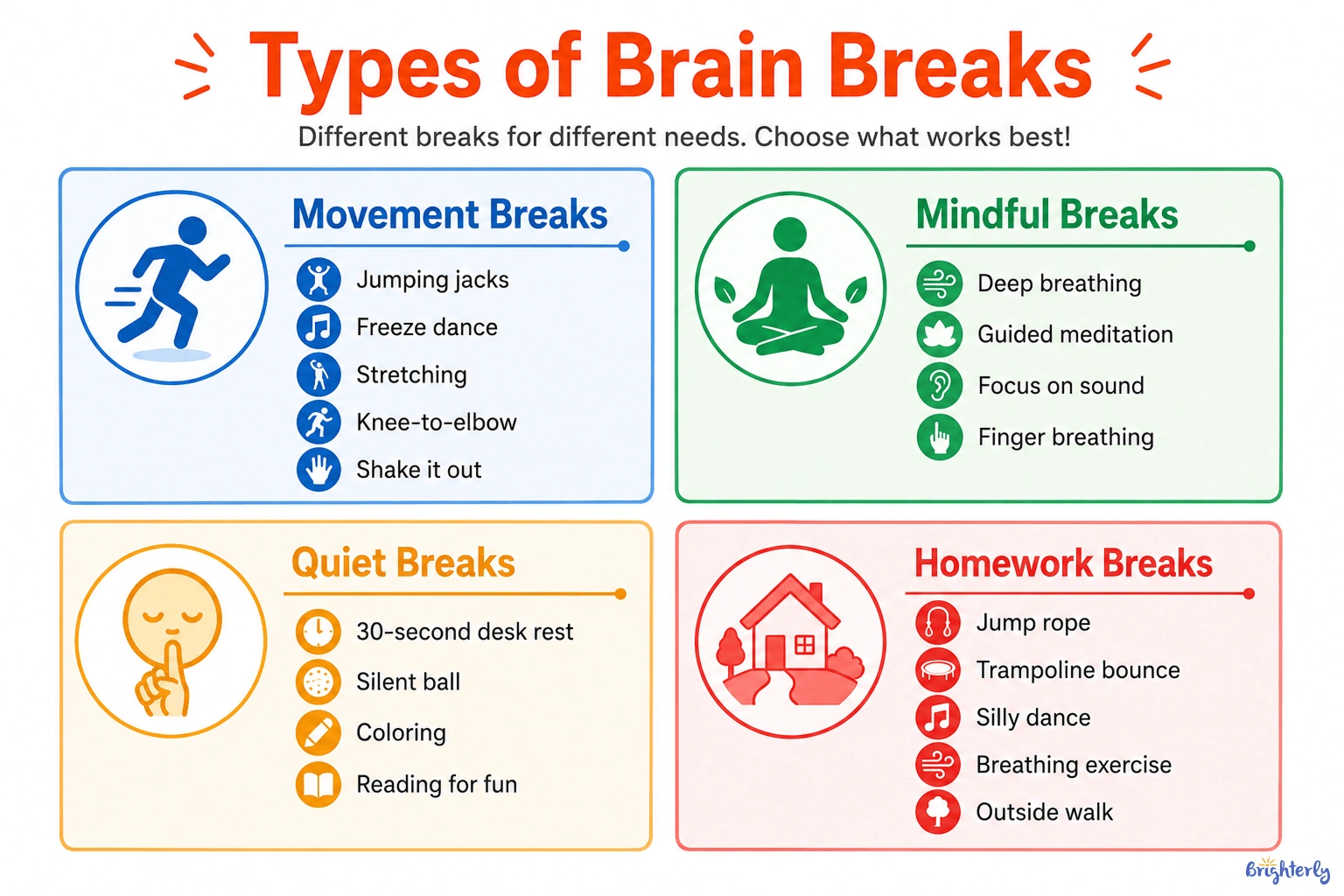

Movement Brain Breaks

Mindful Brain Breaks

Quiet Brain Breaks
When the classroom is already noisy, the educators can bring a study break that centers around quiet practice. It’s a powerful strategy that’s often applied after lunch, before tests, or when the class craves a reset. What are great, quiet but fun brain breaks that focus?
- 30-second desk rest or stretch. Ask kids to sit quietly in their chairs and stretch for exactly 30 seconds. It’s important that the room is quiet during this time.
- Silent ball. This exercise allows supporting kids’ focus with a physical activity. Ask kids to stand up and to pass a soft ball around the room every 2-5 seconds. A person who makes a noise or drops the ball sits down and waits.
- Drawing for fun (3-5 min). When kids disconnect, they automatically start to doodle. So, anticipate it. You can add a free drawing session with no prompts or evaluation to activate the creative parts of the brain and let the cognitive overload fade away a bit.
- Coloring a pattern (3-5 min). For this activity, you will need to prepare sheets with certain geometric patterns. Ask kids to color sheets based on a pattern. It will help them regain concentration by shifting to motoric exercises and calming the activity.
- Observing a calm image (1-2 min). Display a photo of nature, for instance, a forest, mountains, or beach, and ask them to notice three things in an image. Give them 60 seconds to observe, then find out the answers. It can help redirect an attention span via observation.
Jen Jones, a curriculum writer at Hello Literacy, suggests a “Draw and Guess” break: students take 30–60 seconds to draw a simple picture, then pass it to another student to guess. A good companion to the quiet drawing break above.
“This type of quick guessing game activates different cognitive skills and provides mental respite.”

Brain Breaks for Homework
Brain breaks are also effective when children lose concentration or get stuck during homework. Often, they have a decrease in cognitive capacity that some would wrongly call laziness.
And a movement break can fix it in minutes, while at home, you have more options and opportunities to make it fun:
- Jump rope (2 min). Make a skipping session or competition together before returning to the desk. It will raise their heart rate and improve blood flow to the brain.
- Dance to a song. Play their favorite song and encourage them to dance. You can try new moves and make it fun. The emotional uplift can make a real difference there.
- Trampoline bounce (2-3 min). At home, instead of an imaginary trampoline, your kids can use a real one, especially if you have one in the garden. Even two minutes will add to the focus and mood.
- Balloon volleyball. Another active game that can help kids reset is the balloon game. Blow up a balloon and play together to try to keep it off the ground using certain parts of the body. It’s great fun.
- Walk around the block (5-10 min). For older children, a short walk outside is a source of great reset, especially for big assignments.


Make learning at home easier with fun breaks
We adapt learning to kids’ needs and know when they need a pause
Brain Breaks for Older Kids: Middle and High School
Brain Breaks for Middle School
Many middle schoolers feel boredom, fatigue, and disinterest; puberty adds stress and attention problems. Breaks here should feel purposeful, not childish:
- Emotional Check-In. Students scan their emotions (emoji or feelings chart), then breathe, practice gratitude, or “throw away” worries on sticky notes. Supports self-regulation. (3–5 min.)
- Mindfulness Break. Eyes closed, deep breaths, calm visualization. Studies show 10 minutes of daily mindfulness can boost science and reading performance.
- Yogi Break. Five minutes of yoga or slow stretching to shift focus and improve coordination.
- Chit-Chat Break. A short off-topic conversation, character debate, or sentence stem (“If I had to choose between being invisible or flying, I’d choose…”).
Brain Breaks for High School
- Rock, Paper, Scissors tournament — quick, competitive, low-prep.
- Find the AI-Generated Picture — four images, one AI-made; students debate which in 1 minute.
- Collaborative Story — each student adds a sentence to a shared doc, then read it back.
- Reset and Breathe — lights off, calm music, 5 minutes to clear the mind.
- Would You Rather — paired discussion of fun dilemmas; add movement by moving to one side of the room per choice.
Claire Law, a relational psychotherapist and senior contributor at Four Minute Books, on the effect of these breaks:
“In my experience, these breaks have transformed the learning environment.”

Why Are Brain Breaks Important?
Brain breaks are important as they help the human brain, especially the one that is developing, to manage cognitive load and, that way, prevent fatigue, improve focus, and support motivation.
The load affects kids’ executive function, and when the latter hits the limit, instruction stops working. In such a case, a short break will reverse the process.
At the same time, the application of short breaks in a classroom results in:
- Increased focus. A break helps the prefrontal to recover, so children can return to tasks with better concentration.
- Maintaining motivation. When students know the break is coming, they feel that they can manage the rest of the task with the effort they have.
- Stress relief. Breaks built around movements and breathing help to reduce the stress level of school students.
- Creativity support. A pause offers a cognitive reset, giving space for children’s brains to make new connections that support creative thinking.
- Physical activity. As the majority of lessons in schools are seat-based, a movement break for kids is among the primary ways they get physical activity during school.
“A drop in focus, increased movement, or high emotions are all signs to look for and things that can lead to errors.”

What the Research Says About Brain Breaks
Research underlines that brain breaks that are short and involve movement contribute to the memory, engagement, comprehension of instruction, and classroom management and behavior.
- A 2016 brain break research by Goodwin et al. found that the students’ focus drops off after 10 minutes of instruction, regardless of age.
- A 2023 study by Paul Ginns on rest breaks and directed attention shows a direct correlation between these terms and underlines that unstructured rest and nature exposure help restore attentional resources.
- Another 2018 Edutopia article indicates positive effects of brain breaks on consolidating information and memories, divergent thinking, reading, and comprehension.
- A 2024 article on brain breaks models underlines that active breaks are crucial in improving classroom behavior; for the right effect, the educators should integrate the models, such as TAS active break models, in the planning stage.
When Should You Use Brain Breaks?
You should use brain breaks before fatigue, boredom, or distraction begins to affect the students’ performance. The simplest principle is to integrate one brain break for every 10-25 minutes of focused work, which will last 1-5 minutes.
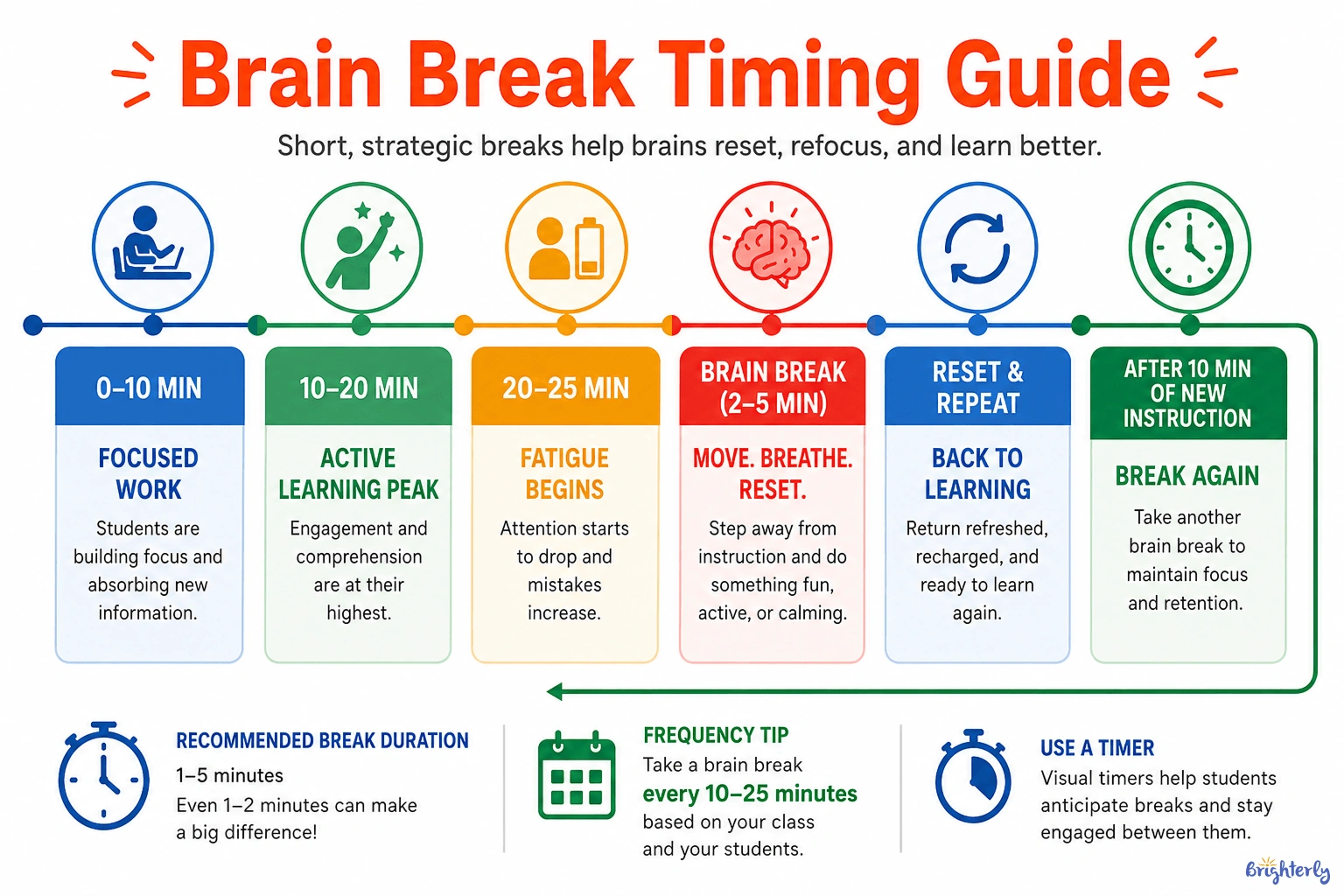
The work and break intervals depend on the age of a child and the demands of the task. The younger the child, the shorter the work interval would be.
- A kindergartener who works on phonics may need a break every 10 minutes, while a confident reader in the 5th grade can maintain their focus for 25 minutes.
- A math lesson may require greater executive function resources, so the brain breaks may be more often, depending on the signs of fatigue, stress, or math anxiety.
Here’s what Alex J Anderson-Kahl, a School Psychologist and Parent Coach, tells about the duration of the brain breaks:
“The brain breaks do not have to be long, but they should be intentional. I recommend setting a timer for 15 minutes.”

Breaks must reflect the learning needs and preferences of the child, especially if learning happens at home.
At Brighterly, a learning platform offering one-on-one tutoring sessions, we build timed brain breaks directly into each session plan. We identify children’s learning needs and then customize each learning experience to their age, level, style, and attention span.
For example, our 3rd grade math tutors and 4th grade math tutors follow this method. That way, we try to keep kids from burnout and support their motivation and confidence levels.
Stop your kid from zoning out mid homework
Our tutors integrate interactive breaks and teach to cope with the load
Brain Breaks for the Classroom: Tips for Teachers
The classroom brain breaks that work often are planned, reflect the needs of the kids, and suit the tasks that kids have.
Dr. Connie McReynolds, a Licensed Psychologist, underlines that the teachers should look at brain breaks for students as a planned part of learning:
In this regard, the great tips to build effective brain breaks in the classroom are:
- Plan breaks before fatigue sets in. Look at your lesson plan and identify when you can add the brain breaks. It may be a 10-20 minute mark, but take into consideration the complexity of the task as well.
- Consider the audience. For instance, when preparing kindergarten brain breaks, consider adding more breaks and making them about movement. It’s what vocabulary tutors implement in lessons to keep kids engaged.
- Set a timer. Make the break visible and clear with the timer. It will help to remove the negotiation and set expectations for the kids.
- Read the room before you choose the type. Finding the right exercise depends on the mood of the class and the learning environment. Feel it and know whether you need to energize or slow down a class.
- Wrap up with a countdown. Set expectations and make breaks predictable. The routine of resuming learning is as important as it affects cognitive reset.
Jessica Plonchak, Executive Clinical Director at ChoicePoint Health, recommends two low-prep classroom games:
“Red Light, Green Light is performed this way: the teacher calls Green Light, and everyone moves to the finish line until Red Light is called.”

Conclusion
Brain breaks are a quick, research-backed way to recharge focus and lift performance — at school, during one-on-one learning, and at home. By mixing physical, mindful, and quiet activities, and adapting them to a child’s age and energy, parents and teachers help kids with concentration, emotional processing, and motivation.
Frequently Asked Questions
How Long Should a Brain Break Last?
A brain break should last from 1 to 5 minutes. Even one minute should be enough for a simple activity, for intense jumping jacks or finger breathing. For guided meditation, three to five minutes are better, ensuring a proper cognitive reset.
How Often Should Kids Take Brain Breaks?
Kids should take a brain break every 10-25 minutes if they are focused on work. The interval may depend on the age and difficulty of a task. The higher the demand for the task, the faster the exhaustion of the kids.
Can Brain Breaks Help Kids With ADHD?
Yes, they can. Children with ADHD benefit from short movement breaks that reduce hyperactivity and support sustained attention. The breaks can help regulate kids’ condition and regain focus after being overwhelmed.
What Are Good Brain Breaks for Middle School Students?
Silent ball, stretching, breathing exercises, and structured brain breaks are good brain breaks for middle school students. For them, brain breaks need to be more about purpose and not feel childish. Thus, a bit of challenge is what kids may like at this age.
Do Brain Breaks Work During Online or Remote Learning?
Yes, they work during remote or online learning. However, you should make small adjustments. For instance, finger breathing, slow-motion wings, and cat yoga just need a chair. Camera off dance gives more privacy for a kid, while Simon Says over video gives control to the teacher, and is one of the effective kindergarten brain breaks.




When a student finds new material hard, the teacher’s guided support is what helps them first understand it, then apply it independently. This is what scaffolding in education is: the ladder set by a teacher allowing them to go on the next level. From this guide, you will learn how scaffolding works, get effective strategies, […]

May 31, 2022

Involvement by parents in their child’s academic process is of great importance to the school. Why? For one, the relationship between teacher and parents can influence student achievement, emotional well-being, and personal development. But the advantages run deeper than that. This article aims to explore the significance of the relationship between teacher and parent for […]
May 31, 2022
Math & reading from 1st to 12th grade
Looking for homework support for your child?

Choose kid's grade

Math & Reading for Grades 1–12
Build real confidence for your child with a Brighterly math or reading tutor.