
Function Transformations Worksheets
Updated on September 10, 2026
Function transformations worksheets give students systematic practice identifying how changes to a parent function’s equation produce predictable shifts, reflections, stretches, and compressions on the coordinate plane.
By working through vertical and horizontal translations, reflections across the axes, and scaling transformations for quadratic, absolute value, and exponential parent functions, students build the graph-reading fluency needed in pre-calculus.
Being able to sketch y = −2|x + 3| − 1 without plotting individual points is the kind of visual-algebraic fluency that high school math tutors help students develop through targeted transformation practice.
Download Function Transformations Worksheet PDFs
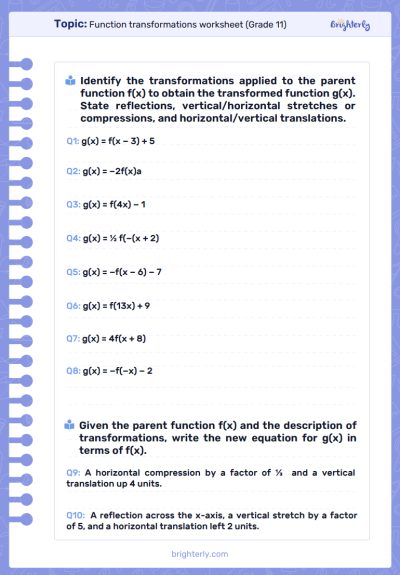
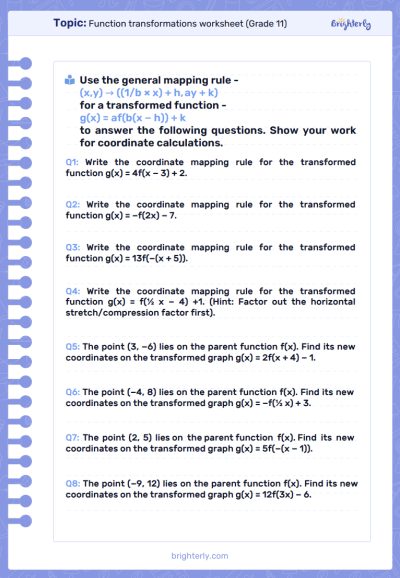
Access our comprehensive collection of printable materials designed to help learners practice identifying and graphing complex function transformations.
More functions and graphing worksheets
Build your function graphing skills with these related resources covering graphing of inequalities and linear functions, exponential function behavior, and broader Algebra 2 equation work — all disciplines where understanding parent functions and their transformations gives students a significant speed advantage.
- graphing linear inequalities worksheets
- graphing inequalities worksheets
- algebra 2 worksheets
- solving exponential equations worksheets
- equations and inequalities worksheets


Help your child reach their full potential!
Answer a few quick questions about your child’s learning, and we’ll recommend next steps.
Benefits of Function Transformations Worksheet
Utilizing a function transformations worksheet provides critical practice in identifying how specific algebraic changes to an equation result in predictable geometric movements on a coordinate plane — the essence of transformation geometry.
By working through various exercises, students learn to distinguish between horizontal and vertical translations, reflections across the x and y axes, and the nuances of vertical and horizontal stretches or compressions.
This systematic approach is vital for success in advanced algebra and pre-calculus, as it builds the foundational skills necessary for analyzing the behavior of quadratic, cubic, absolute value, and exponential functions.
Mastering these transformations allows learners to sketch graphs accurately without relying solely on point-by-point plotting, fostering a more intuitive grasp of functional relationships. Furthermore, these worksheets help students connect the abstract thinking of a function with its visual output, enhancing their ability to interpret mathematical models in real-world contexts.
Consistent practice with these concepts ensures that students can confidently manipulate parent functions and solve complex problems involving composite transformations, ultimately preparing them for higher-level calculus and STEM-related coursework where graphical analysis and function behavior are paramount.


Math & reading from 1st to 12th grade
Looking for homework support for your child?

Choose kid's grade

Math & Reading for Grades 1–12
Build real confidence for your child with a Brighterly math or reading tutor.