Summer Math Activities: 10 Easy Ways to Keep Kids Sharp
reviewed by Rachelle Bencio Yu
Updated on June 19, 2026
Key Takeaways: Fun summer school math activities are at-home designed tasks for a child that help them improve math skills, clear basic math concepts and prevent summer slide during the summer vacation. These can be done through field trips, cooking and baking, family activities and math games, like Jeopardy, Bingo and Monopoly, to make them more enjoyable for kids. Math Activity Learning Goals Time Estimates Ages Suitable For Cook and bake together Measuring, doubling and halving ingredients and cutting final dish into parts: teaches fractions, counting, additions and subtractions. Indoor and at-home activity. 45 minutes -1 hour. 6-10 years Kindergarten and elementary students Turn grocery trips into math games Teaches about budgeting, financing, discounts, price comparison and spending and saving. Outdoor activity. 30 minutes – 1 hour. 7-11 years. Elementary students. Play math board games and card games Number recognition, counting, adding, subtracting and multiplying, Indoor activity. 15-30 minutes. 6-12 years. Elementary students. Go on a math scavenger hunt Measuring lengths and shape recognition. Outdoor activity. 30 minutes – 1 hour. 4-6 years. Preschool and kindergarten. Practice math facts with short daily drills Counting, addition, subtraction and multiplication. Indoor activity. 15-30 minutes. 5-10 years Preschool, kindergarten and elementary students. Build and measure with LEGO and blocks Length and measurement, addition, subtraction and shape recognition. Indoor activity. 15-30 minutes. 5-10 years. Preschool and kindergarten. Take math outside with sidewalk chalk Addition, subtraction, counting and multiplication. Outdoor activity. 15-30 minutes. 6-12 years. Preschool, kindergarten and elementary students. Dig into sports stats Average, ratios and percentages. Indoor activity. 30 minutes – 1 hour or more. 7-12 years. Elementary students. Plan a budget, trip or lemonade stand Investment, profit and loss and saving. Outdoor activity. 1-3 hours or more. 7-12 years. Elementary students. Use math apps and online games Word problems, puzzles, additions and fractions. Indoor activity. 15-30 minutes. 7-12 years. Elementary students.
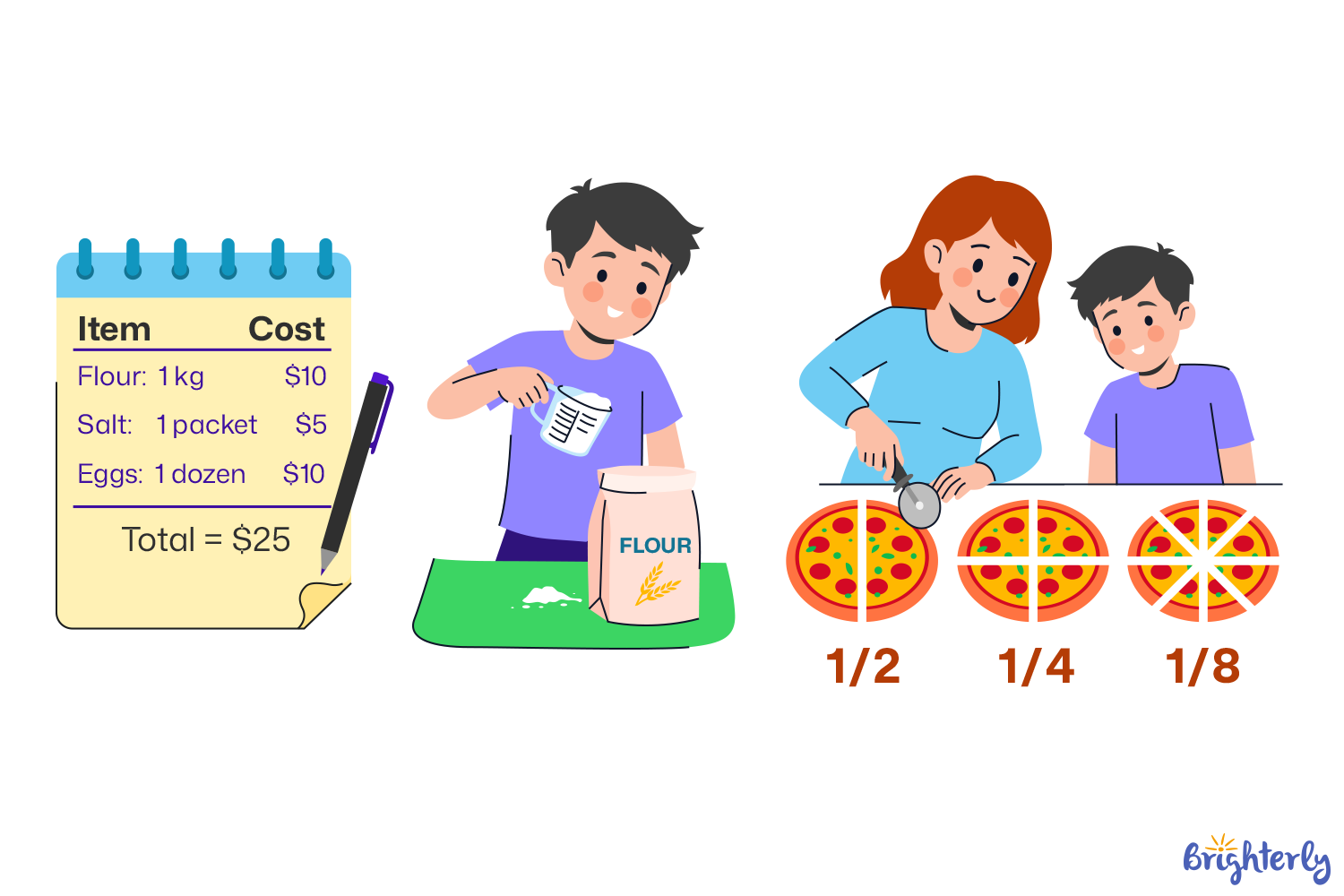
Learn how Brighterly helps students with math practice through online or at-home sessions. Cooking and baking help teach math concepts to kids, like addition, subtraction, measurement, fractions and doubling and halving ingredients. It can be the most fun way to practice math over the summer if your child enjoys cooking. Involving kids in cooking and baking helps them learn basic life skills from a young age. Studies show that acquiring cooking skills at an early age is essential to develop or boost confidence, skill retention and healthy eating habits (Muzaffar, Barrett, & Check, 2022) (Vaughan et al., 2026). Now, the main task is to include math in cooking and baking. Here is how you can do it: Budgeting and Financing Start by teaching your child that the first step of cooking is to budget, shop, and gather all the ingredients required. Tell them how frustrating it can be if you are in the middle of cooking an exciting dish and find out one ingredient is missing. It can destroy your whole recipe! So, you can: Measuring Ingredients After gathering all the ingredients, tell your kids the importance of correct measurements in cooking and how the wrong measurement can affect the overall recipe. Next, take out the measuring cups and spoons from your cabinets and show children how to measure, half and double each ingredient and put them aside. Teaching Fractions Slicing and cutting any ingredient or your final dish is a great way to teach your kids fractions. For example, you can bake a pizza or pie, then cut it into half, then 1/4th, and then 1/8th. Explain to your child in simple words that these are fractions, also known as a part of any substance. You can also remove toppings from some parts of the pizza and ask your kid to calculate how much of the pizza has the toppings and how much does not. Planning weekly groceries with your kid offers a practical way to educate your child on how a house runs. It can give them the understanding of discounts, sales, price comparison of different brands, budgeting and the importance of saving money and utilizing it elsewhere. To make this summer math activity more fun, give your child a challenge in each grocery trip and plan a reward at the end. For example, you can ask your child to compare the prices of two specific brands and ask their thoughts on it. Ask your kid to note down which brands offer discounts and which of them is the most costly. Another fun activity for your child on grocery trips is that you can give them some amount of money and ask them to buy a few listed items. However, their task will also be to save some money. Playing math board and card games with your children is an effective method to make learning math entertaining. Research shows that board games help improve the mathematical skills of children aged 3 to 8 years (Balladares, Miranda, & Cordova, 2023). Above all, math board games help give you quality and family time with your kids, cutting down on screen time and strengthening the bond between you and your child. Fun and easy card and board games for kids can include Snakes and Ladders, LUDO, Monopoly, UNO, and Scrabble. A math scavenger hunt is when you avoid the traditional desk math worksheets and plan an outdoor or indoor math activity for your child. For example, while taking kids to the park or for any outdoor entertainment, ask them to find a circular object, a 3D shape, an object with four sides or a 90-degree angle, or others. Some examples of an indoor math scavenger hunt can be: Remember, you can plan the math games for kids based on what you want them to learn or according to their school math course. Practicing short daily drills can help improve your kids’ math skills. For example, you can utilize household items or art projects to practice addition facts and multiplication facts. When you are in the middle of doing a house or kitchen chore, ask your child how many onions are left and how many will be there if you add 10 more. Moreover, give them a time limit to calculate. With the help of daily examples, teach your child how multiplication can help add large numbers fast. These examples can develop an interest in learning tables at their fingertips. Studies suggest that using real-life examples or situations helps build a foundation for math knowledge and improves quantitative literacy skills (Knabbe, Leiss, Ehmke, & Education, 2024).
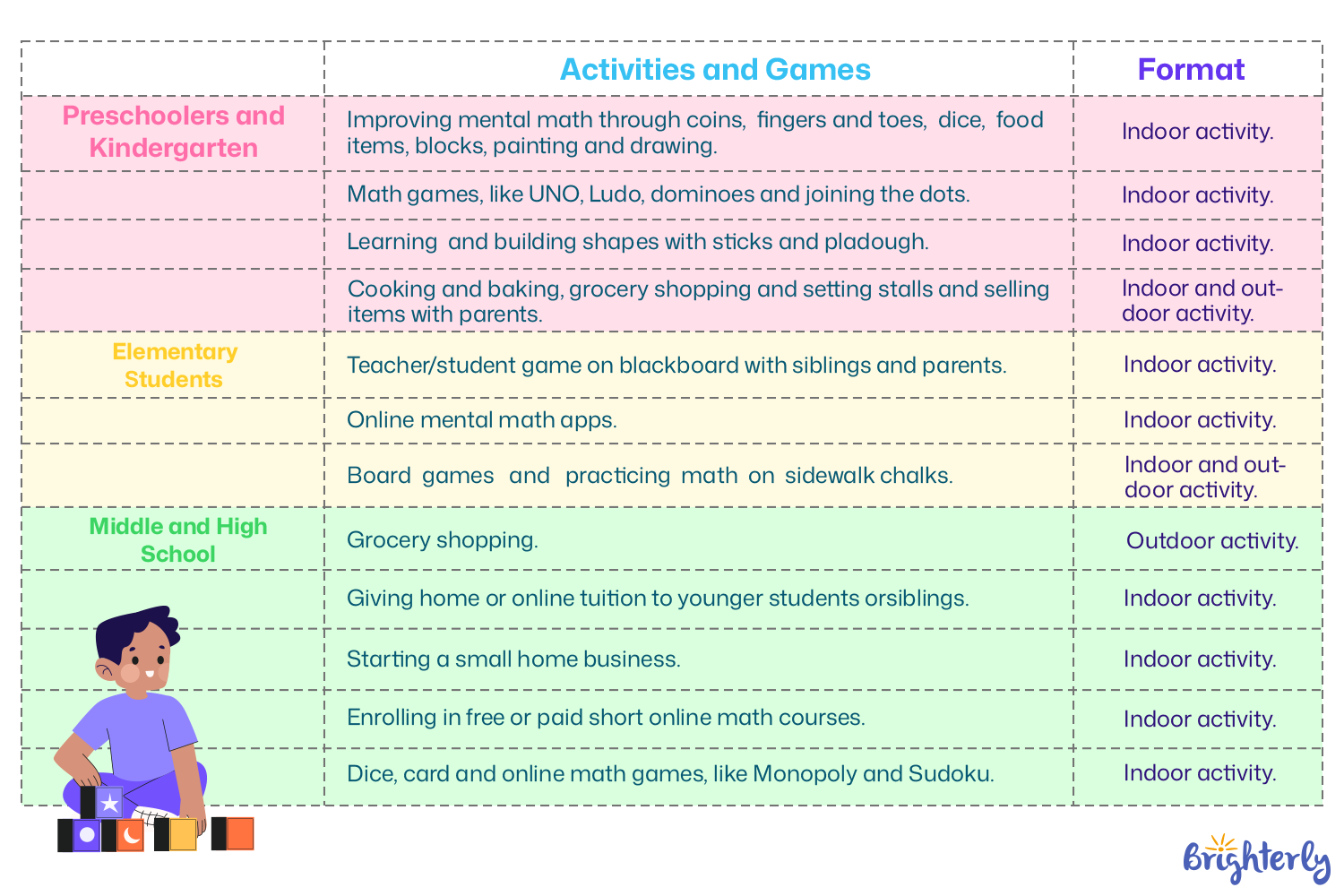
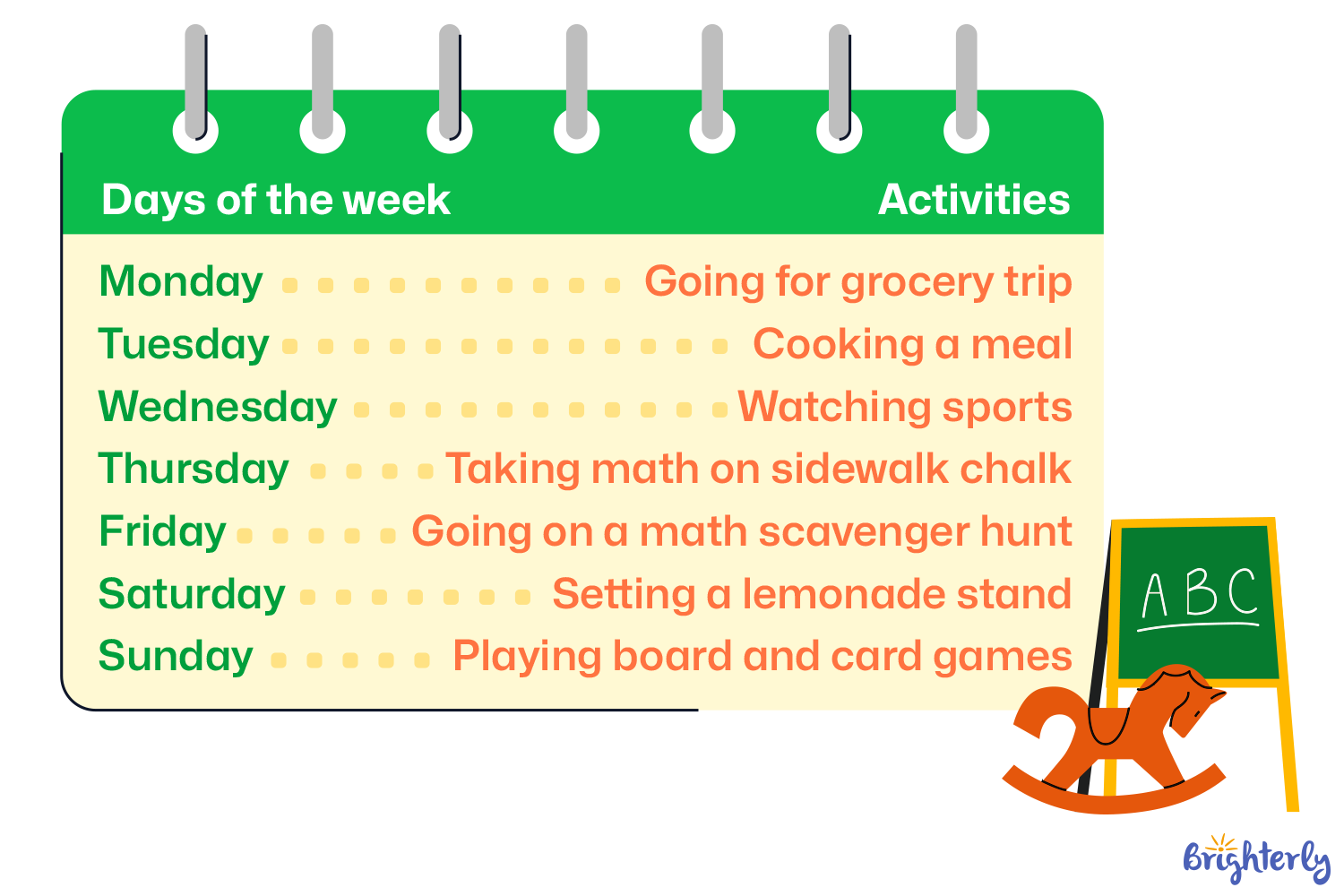
Learn how our expert tutors help kids improve their math skills. Playing and building Lego or blocks serves as a great way to teach and learn math concepts, like addition, subtraction and measurement. Kids can enjoy playing and drawing with chalk. Drawing numbers on sidewalks and then jumping or hopping on them is a fun game that can help with summer math practice. You can also give addition, subtraction and multiplication sums to children to solve on paper sideways and whoever solves them first or correct can get a reward. Another fun summer math activity is to watch and dig sports stats with your kids. It can help teach them how to calculate and read scores and clear their concepts of average, ratios and percentages by tracking performances. Moreover, you can explain to your kid how to calculate whether a team is winning or losing. You can plan it like a movie, gather some snacks or cook their favorite meal, and decide which team everyone is with to make the activity even more entertaining. Selling helps a child learn the concept of business maths, including investment, profit and loss, and gives them a chance to make their own money. Planning a summer vacation trip or teaching your child the art of selling by organizing stands or stalls, like fresh homemade juices, lemonade or cookie stalls, can be one of the most enjoyable and productive summer math activities for kids. Using math apps and online games, like SplashLearn, Prodigy, Math Playground and Khan Academy, are other ways to incorporate summer math practice into your kids’ routine. Select fun math games from the internet and play them together with your kid. Platforms, like Brighterly, offer a structured way to improve your child’s math skills according to their age and grade. Research shows that using digital resources helps reduce early math skill gaps in children (Bresciani, Kalil, Liu, Mayer, & Shah, 2026). Learn exactly how Brighterly helps students thrive through expert sessions, online tools, and proven feedback from thousands of satisfied parents Let’s divide a few other summer math activities by age and grade. Below are assorted preschool math games and activities, math games for first graders and elementary students. Summer school math activities not only help prevent the summer slide but keep your child’s mind busy and active without giving them formal study pressure. The only key is to incorporate these activities into things your child loves doing. Yes, summer math activities can prevent the summer slide, especially if you plan hands-on activities according to your child’s school curriculum. But remember, your main goal should be to plan these math activities in a way that your child finds entertaining instead of scheduling it as traditional homework or studies. A structured summer program is a formal learning program where your child has to go outdoors to attend it regularly or on some days of the week in the summer months (Catherine H. Augustine, 2025). It is like a summer camp, but it can be costly and require fixed timings. On the other hand, free summer math activities are budget-friendly, entertaining and offer flexible timings without giving formal study pressure to a child. Moreover, they can be designed as a part of a daily routine and based on your child’s individual needs. Yes, definitely but it depends if your child’s basic concepts and current grade learnings are already on fingertips and clearly understood. Only then should you move towards teaching them further, or else it is better to stick to their current syllabus and class. Yes, kids need worksheets apart from everyday summer math activities. Learning through everyday activities cannot be an all-time substitute for practicing through worksheets. Worksheets give your child a structured exam pattern and prepare them for future tests. Superprof works if you have enough time to self-sort teachers’ profiles. For anyone tired of comparing unvetted listings, the 8 Superprof alternatives below cover every use case — with featured up-to-date pricing and the information on who they’re best for. Best Superprof Alternatives at a Glance Platform Best for Starting Price (as of June 2026) Free […] Jun 16, 2026 If your child is struggling to remember how to use a colon and semicolon, they’re not alone. In fact, mixing up these two punctuation marks is one of the most common writing mistakes that children (and adults!) make. This article breaks down what exactly a colon and semicolon are, how to use them correctly, and […] Jun 19, 2026
10 Summer Math Activities to Keep Skills Sharp
Format


Improve Your Child's Math Skills with Brighterly.
Cook and Bake Together
Turn Grocery Trips into Math Games
Play Math Board Games and Card Games
Go on a Math Scavenger Hunt
Practice Math Facts with Short Daily Drills
Explore Various Brighterly Math Tutor Programs
Build and Measure with LEGO and Blocks
Take Math Outside with Sidewalk Chalk
Dig Into Sports Stats
Plan a Budget, Trip, or Lemonade Stand
Use Math Apps and Online Games
Explore Brighterly Learning Experience
Summer Math Activities by Age and Grade
Summer Math Activities for Preschoolers and Kindergarten
Summer Math Activities for Elementary Students
Summer Math Activities for Middle and High School
Quick Tips to Keep Summer Math Fun and Consistent
Conclusion
Frequently Asked Questions
Do Summer Math Activities Actually Prevent the Summer Slide?
How Do Free Summer Math Activities Compare to a Structured Summer Program?
Can Summer Math Activities Help a Child Get Ahead Before the New School Year?
Do Kids Need Worksheets, or are Everyday Activities Enough for Summer Math?





Math & reading from 1st to 12th grade
Looking for homework support for your child?

Choose kid's grade

Math & Reading for Grades 1–12
Build real confidence for your child with a Brighterly math or reading tutor.