
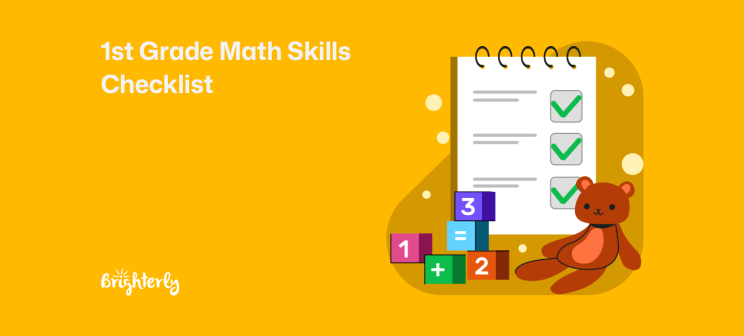
1st Grade Math Skills Checklist
reviewed by Jessica Kaminski
Updated on September 2, 2026
Key Points:
- 1st grade math skills build on each other and set the ground for the subsequent growth and math learning of a kid.
- Key grade math concepts vary in difficulty and essence, including counting to 120, understanding and using shapes, and even interpreting data.
- A checklist can help you identify whether a kid is on a math track and see the signs when support is needed.
Moving from kindergarten to first grade may be quite a leap for a child. There, what can ensure kids’ growth is understanding the math skills they should learn. This 1st grade math skills checklist explains “what do 1st graders learn in math” and shares a few tips for parents.
Core Math Skills Every 1st Grader Should Know
The core math skills every 1st grader should know are:
- Counting, reading, and writing numbers to 120
- Addition and subtraction within 20
- Solving addition and subtraction problems
- Understanding place value
- Comparing two-digit numbers
- Adding within 100 and subtracting multiples of 10
- Measuring and comparing lengths
- Telling time
- Organizing and interpreting data
- Composing shapes and dividing into equal shapes


Close 1st grade math skills gaps with tutoring
Brighterly tutors create lesson plans based on kids' needs and gaps
Counting, Reading, and Writing Numbers to 120
The primary skill your kid learns by the end of first grade relates to counting, reading, and writing numbers up to 120. Importantly, at this stage, they master counting starting from any given number rather than always from one.
For this, the teacher builds the skill through daily routines, number lines, and hundred charts. It allows the kid to develop the strong number sense necessary for the subsequent skills on this first grade math skills checklist.
Addition and Subtraction Within 20
Besides, math skills for 1st grade involve addition and subtraction within 20. Teachers or tutors introduce addition and subtraction first with objects and drawings, then with equations. Kids can learn in school or at home by using strategies:
- Counting on
- Making ten
- Using double facts (like 6+6)
For extra practice at home, explore 1st grade math worksheets covering key skills, or use targeted subtraction worksheets for grade 1.
Solving Addition and Subtraction Word Problems
Once basic 1st grade math concepts on addition and subtraction are covered, children should switch to the related word problems.
They should include scenarios involving one or two steps of adding to, taking from, comparing, or putting together. It allows you to link the math concepts to real-world problem-solving. Importantly, it may be hard for kids to master.
Understanding Place Value: Tens and Ones
Place value lays the ground for understanding other 1st grade math ideas. In particular, a kid learns that a two-digit number represents a bundle of tens and some extra ones. Knowing it prepares them for adding beyond 100.
Comparing Two-Digit Numbers
Another early math skill lies in comparing two-digit numbers based on the values of the tens and ones digits. For this, you should introduce the kids to using symbols such as <,=, and >.
Adding Within 100 and Subtracting Multiples of 10
During the first half of 1st grade, children learn to add a two-digit number and a one-digit number, and add a two-digit number and a multiple of ten via models, strategies, and drawings.
Also, they learn how to subtract multiples of ten from multiples of ten within 100. Consider that’s one of the more advanced math skills for the 1st grade checklist.
Measuring and Comparing Lengths
During the first year, kids learn how to measure objects using rulers or other objects, such as paper clips. It’s an important skill to build intuition before more formal ways to measure things.
For instance, to measure the length of a pen or pencil, a kid would use a paper clip as a repeated unit to find out the length of objects. At home, you can use different objects and turn them into a game.
Telling Time to the Hour and Half-Hour
Another math skill to learn in the first grade refers to telling time and understanding the concept of time. Your child should learn to read and write time on analog and digital clocks to the hour and half-hour. At the same time, they will learn how to connect time and events.
As reading analog clocks can be tricky, you can buy a clock for home and use telling time worksheets for hands-on practice with reading clock faces at home.
Organizing and Interpreting Simple Data
Seeing this skill in the checklist may be surprising for a parent. Learning to organize data sounds like statistics, right? Yet, for a first grader, it’s more about learning how to collect and organize data to operate it. So, they study how to:
- Gather and represent data with pictures or other visual tools
- Explain and interpret data
- Use vocabulary related to numbers, problems, and comparison, for instance, “more” or “less”
- Make judgments and conclusions based on simple data.
Bringing this skill so early helps a child develop critical thinking.
Note. At home, you can ask kids to record objects around them and turn them into graphs or drawings for practice.
Composing Shapes and Dividing Them Into Equal Shares
Even though kids learn some basic shapes in kindergarten, they develop an understanding of them further in the first grade. In particular, kids learn how to explore and recognize attributes of various shapes.
So, at the end of the 1st year, they can name and draw shapes, build new shapes, distinguish between defining and non-defining attributes, and break circles and rectangles into shares.
Note. Parents can try a game that involves naming objects around them.
Explore Brighterly Learning Experience
Learn exactly how Brighterly helps students thrive through expert sessions, online tools, and proven feedback from thousands of satisfied parents
Can Your Child Do These 1st Grade Math Tasks?
- Count forward starting from any number up to 120
- Add and subtract fluently within 20
- Use objects and drawings to give a solution to a simple word problem
- Explain what the tens and ones digits mean
- Use <, =, > to compare numbers
- Tell time and measure lengths
- Read simple graphs and use vocabulary to answer questions like “how many more?”
- Split shapes into two or four equal parts.
Use it as a checklist to find out whether your kid is good at this skill. At the same time, you can use a free 1st grade math test that may give a more complete overview while being interactive for a kid.
Signs Your Child May Need Extra Support in 1st Grade Math
- Your kid counts one by one and ignores skip-counting or grouping.
- Overuses fingers for every addition or subtraction
- Finds it hard to explain what a two-digit number is concerning tens and ones
- Loses confidence and avoids doing math problems
- Struggles to tell whether one number is bigger or smaller than another one
Once you see that a kid shows several signs, it may be a sign that your kid may have foundational math gaps. For a larger picture, you may want to resort to the 1st grade readiness checklist to see whether they have other gaps.
Next, you can switch to a private tutor or tutoring platform to close the gaps. At Brighterly, a reading and math tutoring platform for K-12, our online math tutors first assess the gaps and needs, and then customize lesson plans to meet kids’ goals, style, and preferences.
Get extra support to improve math skills
Let professional tutors make 1st grade learning engaging and relevant for your kid
Conclusion
Look at this checklist as a document you can revisit before, during, or after first grade. It allows you to find gaps.
If you just want to reinforce a skill, explore our math games for grade 1; if you want to test your kid, take a quick quiz to get a personalized plan.
Nevertheless, as the skills in this list build on each other across elementary school, finding and addressing the gaps can make learning easier for a kid later. So take into account other skills and categorization of math skills by grade:
Frequently Asked Questions
How High Should a 1st Grader Be Able to Count?
A 1st grader, by the end of the grade, should be able to count up to 120, whether starting from 1 or any given number. As children already know how to count to 20, 50, or 100, they practice counting forward, backward, or counting by 2s or 10s. They also learn to read and write numerals up to 120.
What Addition and Subtraction Facts Should a 1st Grader Know?
By the end of the first grade, a child should know how to add and subtract within 10 and understand concepts and facts up to 20. For this to happen, they won’t focus on memorization. Instead, they will learn to apply techniques such as making 10, using doubles and near doubles, counting on and back, understanding fact families or inverse relationships, and three addends.
Is It Normal for a 1st Grader to Use Fingers for Addition and Subtraction?
Yes, it’s normal for a 1st grader to use fingers to add or subtract numbers. The rationale lies in the idea that the act of counting builds a mental bridge or a tool to visualize abstract concepts. It allows them to comprehend basic ideas and then move to memory-based calculation or strategies. Usually, kids drop the habit of using fingers on their own, but you can also encourage them to make a transition by building number bonds or providing visual tools.
Do 1st Graders Learn Fractions?
Math for 1st graders involves learning fractions, in particular, foundational concepts, yet they do not write complex numbers like 3/4. The fractions that they learn would focus on geometry or sharing, including cutting shapes into pieces, identification of halves and fourths. The full fraction is often introduced to children in the third grade.
What Math Skills Should a 1st Grader Master before 2nd Grade?
Before a child starts learning in the second grade, they should master addition and subtraction within 20, count up to 120, and know how to tell time or even read simple graphs. These skills should be the basis for any first grade math skills checklist.


For the majority of parents, a good report card marks the end of any discussion; if the letter grades are satisfactory, it is assumed that the child is doing all right, and an A in particular doesn’t lead them to investigate further. Brighterly wanted to find out whether a good grade tells parents what they […]

Aug 31, 2026
After the first two years, your kid may have some basics. Yet, it’s the third year when the math starts to look like “real” math. And if you’re not sure what your kid should know by the end of it, this 3rd grade math skills checklist will help you. It breaks down what to expect […]

Sep 02, 2026
Math & reading from 1st to 12th grade
Looking for homework support for your child?

Choose kid's grade

Math & Reading for Grades 1–12
Build real confidence for your child with a Brighterly math or reading tutor.